Periodic Table: Classifications quiz #4 Flashcards

Periodic Table: Classifications quiz #4
Control buttons has been changed to "navigation" mode.
1/40
  • Which of the following is a property of metalloids?

    Metalloids can conduct electricity but are brittle.
  • How are elements in the periodic table arranged?

    By increasing atomic number.
  • What do we call the rows of the periodic table?

    Periods.
  • Which is a property of metalloids?

    Metalloids have properties intermediate between metals and nonmetals.
  • What are the properties of nonmetals?

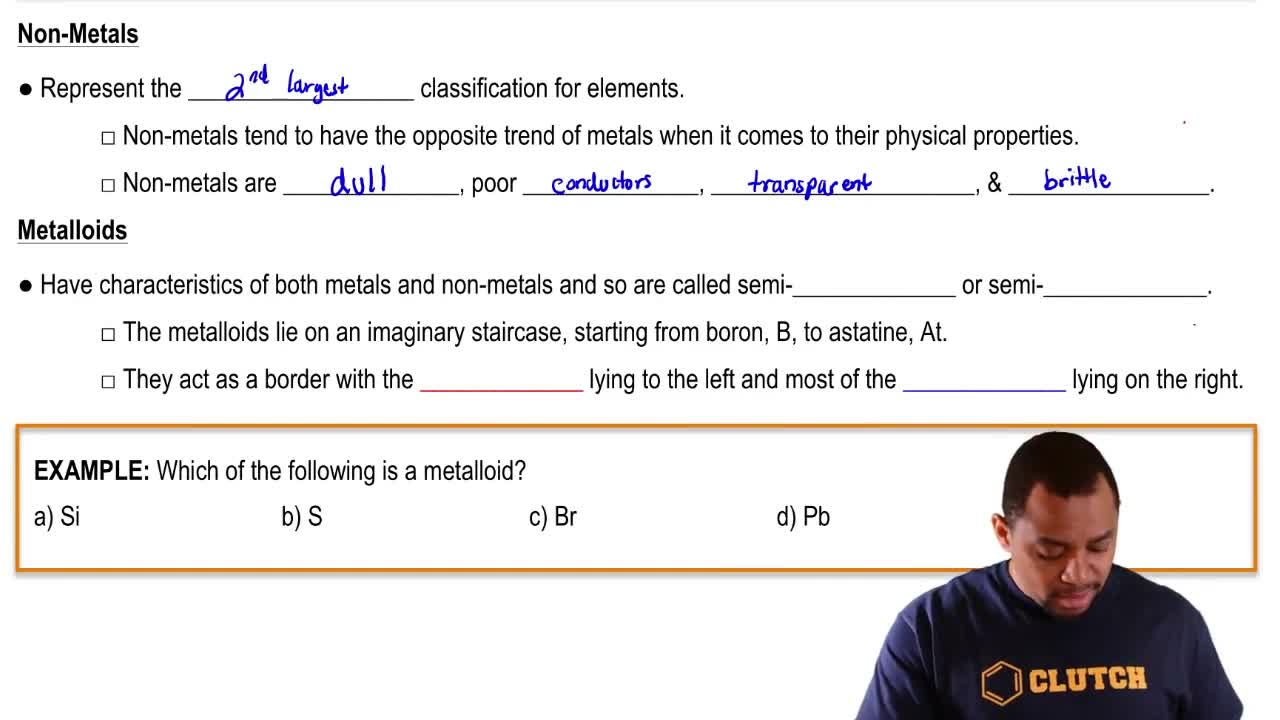
    Nonmetals are dull, poor conductors, can be transparent, and are brittle.
  • What is the basic theme of organization in the periodic table?

    Elements are organized by increasing atomic number and recurring chemical properties.
  • Which of the following is a characteristic of the modern periodic table?

    Elements are arranged by increasing atomic number.
  • Which of the following elements is a transuranium element?

    Plutonium (Pu) is a transuranium element.
  • How did Mendeleev arrange the first periodic table?

    By increasing atomic mass and grouping similar elements.
  • How are the elements organized into the periodic table?

    By increasing atomic number and similar properties.
  • What are unique about metalloids?

    Metalloids have properties of both metals and nonmetals.
  • Elements from period 3 of the periodic table are highlighted. Which element is a metalloid?

    Silicon (Si) is the metalloid in period 3.
  • How are the elements in the current periodic table arranged?

    By increasing atomic number.
  • How are the elements in the periodic table arranged?

    By increasing atomic number.
  • What does it mean that the relationship is “periodic”?

    It means that certain properties repeat at regular intervals as atomic number increases.
  • Which class of elements is malleable?

    Metals are malleable.
  • How many elements are in your periodic table?

    There are 118 elements in the periodic table.
  • Which elements have properties of both metals and nonmetals?

    Metalloids have properties of both metals and nonmetals.
  • What did Dmitri Mendeleev create?

    He created the first periodic table.
  • Where are metal atoms located on the periodic table?

    On the left and center of the periodic table.
  • What do sodium and chlorine have in common?

    Both are elements found on the periodic table.
  • Which of the following is not a characteristic of metals?

    Brittleness is not a characteristic of metals.
  • What are properties of metals?

    Metals are shiny, good conductors, opaque, and malleable.
  • How is the modern (current) periodic table organized?

    By increasing atomic number.
  • What kind of properties do metalloids have?

    Metalloids have properties intermediate between metals and nonmetals.
  • What is Mendeleev is known for?

    Creating the first periodic table.
  • Which group of elements contains a metalloid?

    Group 14 contains metalloids such as silicon and germanium.
  • Which of the following groups on the periodic table does not contain a metal?

    Group 18 (noble gases) does not contain a metal.
  • Which elements are found on the right side of the periodic table?

    Nonmetals are found on the right side.
  • In which block of the periodic table is uranium (U) found: s block, d block, p block, or f block?

    Uranium is found in the f block.
  • Which element is a transuranium element?

    Plutonium (Pu) is a transuranium element.
  • Where on the periodic table are metalloid elements most likely found?

    Along the staircase between metals and nonmetals.
  • Which type of element has properties that are intermediate between metals and nonmetals?

    Metalloids.
  • What is the fundamental organizing principle of the periodic table?

    Increasing atomic number.
  • Where are metals found on the periodic table?

    On the left and center.
  • What is the law of octaves?

    The law of octaves is an early observation that properties of elements repeat every eighth element.
  • How are the elements arranged in today's modern periodic table?

    By increasing atomic number.
  • Which of the following is a property of a nonmetallic element?

    Nonmetals are brittle.
  • Which of the following sets of elements has the most similar physical and chemical properties?

    Elements in the same group, such as the halogens, have similar properties.
  • Which of the following are characteristic of the modern periodic table?

    Elements are arranged by increasing atomic number and grouped by similar properties.