General Chemistry
My Course
Learn
Exam Prep
AI Tutor
Study Guides
Textbook Solutions
Flashcards
Explore
My Course
Learn
Exam Prep
AI Tutor
Study Guides
Textbook Solutions
Flashcards
Explore
Back
Periodic Trend: Electronegativity quiz #3
You can tap to flip the card.
Which of the following statements about electronegativity is false?
You can tap to
flip the card.
👆
Which of the following statements about electronegativity is false?
Electronegativity does not decrease across a period; it increases.
Track progress
Control buttons has been changed to "navigation" mode.
1/15
Related flashcards
Related practice
Recommended videos
Guided course
02:10
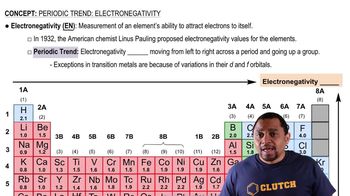
Electronegativity Trends
Jules
4152
views
33
rank
1
comments
Guided course
00:35
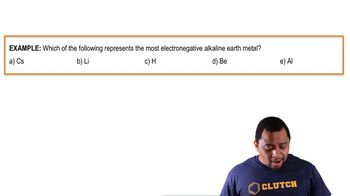
Electronegativity Example
Jules
4543
views
18
rank
1
comments
Terms in this set (15)
Hide definitions
Which of the following statements about electronegativity is false?
Electronegativity does not decrease across a period; it increases.
Which of these refers to the relative ability of an atom to attract electrons?
Electronegativity refers to the relative ability of an atom to attract electrons.
Which statement identifies the electronegativity trends on the periodic table?
Electronegativity increases across a period and decreases down a group.
Which term describes the degree to which an element attracts electrons?
Electronegativity describes the degree to which an element attracts electrons.
Which of the following options correctly describe electronegativity? Select all that apply.
Electronegativity increases across a period, decreases down a group, and measures electron attraction.
Which statement best describes the electronegativity of an element?
Electronegativity is an element's ability to attract electrons in a chemical bond.
Which diagram correctly depicts the trend in electronegativity?
A diagram showing increasing electronegativity from left to right and bottom to top is correct.
Use your knowledge of electronegativity to pick out the most polar bond in the list below.
The bond with the largest electronegativity difference, such as H-F, is the most polar.
What does the electronegativity model explain?
The electronegativity model explains how atoms attract electrons and form polar bonds.
The fact that oxygen is an atom that is strongly electronegative means that:
Oxygen strongly attracts electrons in chemical bonds.
Imagine if O and H had the same electronegativity, what would that do to the properties of water?
Water would be nonpolar and lose its unique properties if O and H had the same electronegativity.
Which statement best describes the electronegativity values of the elements shown?
Elements on the right and top of the periodic table have higher electronegativity values.
Where is the lowest electronegativity found?
The lowest electronegativity is found at the bottom left of the periodic table.
Arrange these elements according to electronegativity.
Arrange elements from lowest to highest electronegativity: left to right and bottom to top.
Arrange these elements according to electronegativity.
Order elements by increasing electronegativity: those on the left and bottom have lower values, those on the right and top have higher values.