General Chemistry
My Course
Learn
Exam Prep
AI Tutor
Study Guides
Textbook Solutions
Flashcards
Explore
My Course
Learn
Exam Prep
AI Tutor
Study Guides
Textbook Solutions
Flashcards
Explore
Back
Physical & Chemical Changes quiz #4
You can tap to flip the card.
When water evaporates, what type of change occurs?
You can tap to
flip the card.
👆
When water evaporates, what type of change occurs?
Evaporation is a physical change.
Track progress
Control buttons has been changed to "navigation" mode.
1/40
Related flashcards
Related practice
Recommended videos
Guided course
01:41
Physical Changes
Jules
17384
views
231
rank
6
comments
Guided course
01:52
Physical Change Example
Jules
11406
views
233
rank
1
comments
Guided course
01:53
Chemical Changes
Jules
10711
views
168
rank
2
comments
Terms in this set (40)
Hide definitions
When water evaporates, what type of change occurs?
Evaporation is a physical change.
What happens to water when it evaporates?
Water changes from liquid to gas, but its chemical composition remains unchanged.
How do particles differ after a chemical change?
Particles rearrange to form new substances with different chemical properties.
What kind of change is boiling water for soup?
Boiling water is a physical change.
An atom loses an electron to another atom. Is this an example of a physical or chemical change?
This is a chemical change.
Which of the following processes does not involve a change in chemical properties?
Melting ice does not involve a change in chemical properties.
Which of the following can indicate that a chemical change has occurred?
Formation of a precipitate can indicate a chemical change.
How do you know that a chemical change has occurred?
By observing formation of new substances or changes in color, gas, temperature, precipitate, or odor.
What are some signs that a chemical reaction might have occurred?
Color change, gas production, temperature change, precipitate formation, and odor change.
Which observation would indicate that a chemical reaction occurred?
Production of a gas or color change.
Which are signs that a chemical change might have happened?
Color change, gas production, temperature change, precipitate formation, and odor change.
Which is not a sign that tells you if a chemical reaction has occurred?
Change in shape is not a sign of a chemical reaction.
How can you tell when a chemical reaction has occurred?
By observing formation of new substances or changes in color, gas, temperature, precipitate, or odor.
What kind of change is burning sugar?
Burning sugar is a chemical change.
Which statement describes one of the main differences between a physical and a chemical change?
A chemical change forms new substances; a physical change does not.
Which of the following accurately describes vaporization?
Vaporization is the process where a liquid changes to a gas.
How can you tell a chemical reaction or change has taken place?
By observing formation of new substances or changes in color, gas, temperature, precipitate, or odor.
Is this a physical change or a chemical change: a campfire?
A campfire is a chemical change.
What is the difference between a physical property and a chemical property?
Physical properties can be observed without changing composition; chemical properties describe how a substance reacts to form new substances.
Which observation most likely indicates that only a chemical change has taken place?
Formation of a new substance most likely indicates a chemical change.
What is not a possible sign of a chemical change?
Change in size is not a possible sign of a chemical change.
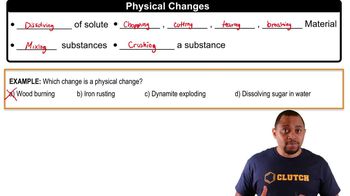
Which of the following is an example of physical change?
Melting ice is an example of a physical change.
The melting of an ice cube is an example of what kind of reaction?
It is an example of a physical change.
Which of the following is not a sign of chemical change?
Change in shape is not a sign of chemical change.
Which of the following is not a possible sign of a chemical change?
Change in physical state is not a possible sign of a chemical change.
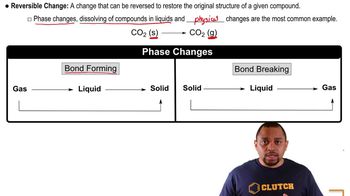
What happens when a solid melts?
The solid changes to a liquid, but its chemical composition remains the same.
Which change of state takes place when a gas loses energy?
Condensation or deposition occurs when a gas loses energy.
What is the main difference between physical properties and chemical properties?
Physical properties can be observed without changing composition; chemical properties involve changes in composition.
Why is melting an ice cube a reversible physical change?
Because the process can be reversed by refreezing the water.
How is ice melting different from burning something?
Ice melting is a physical change; burning is a chemical change that forms new substances.
How do you know if a chemical reaction has occurred?
By observing formation of new substances or changes in color, gas, temperature, precipitate, or odor.
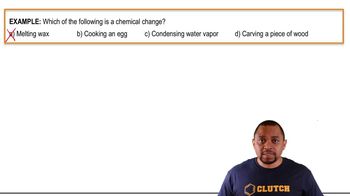
Which of these is a chemical change?
Cooking an egg is a chemical change.
Why is ice melting not a chemical change?
Because the chemical composition of water does not change.
Which is not an example of a chemical change?
Boiling water is not a chemical change.
Which is an example of chemical change?
Burning wood is an example of chemical change.
What type of change forms a new substance?
A chemical change forms a new substance.
How can you determine if a physical or chemical change has occurred?
Check if the substance's chemical identity has changed; if so, it's chemical; if not, it's physical.
How can a chemical change be reversed?
Most chemical changes cannot be reversed under normal conditions.
What happens to the salt during evaporation?
Salt remains as a residue after water evaporates.
Which is the process by which a solid changes to a liquid?
Melting is the process by which a solid changes to a liquid.