Skip to main content
General Chemistry
My Course
Learn
Exam Prep
AI Tutor
Study Guides
Textbook Solutions
Flashcards
Explore
Try the app
My Course
Learn
Exam Prep
AI Tutor
Study Guides
Textbook Solutions
Flashcards
Explore
Try the app
Back
Parts per Million (ppm) quiz
You can tap to flip the card.
What does 'parts per million' (ppm) represent in solution concentration?
You can tap to flip the card.
👆
What does 'parts per million' (ppm) represent in solution concentration?
Ppm represents the number of parts, either in grams or milliliters, per one million parts of solution.
Track progress
Control buttons has been changed to "navigation" mode.
1/15
Related flashcards
Related practice
Recommended videos
Parts per Million (ppm) definitions
Parts per Million (ppm)
15 Terms
Parts per Million (ppm) quiz #1
Parts per Million (ppm)
11 Terms
Parts per Million (ppm)
14. Solutions
4 problems
Topic
Jules
Mole Fraction
14. Solutions
4 problems
Topic
Jules
14. Solutions - Part 1 of 3
4 topics
8 problems
Chapter
Jules
14. Solutions - Part 2 of 3
5 topics
10 problems
Chapter
Jules
14. Solutions - Part 3 of 3
5 topics
6 problems
Chapter
Jules
Guided course
01:11
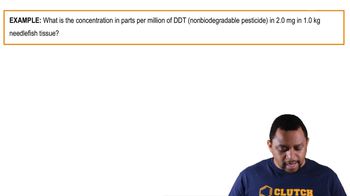
PPM Calculation Example
4313
views
27
rank
2
comments
Guided course
01:23
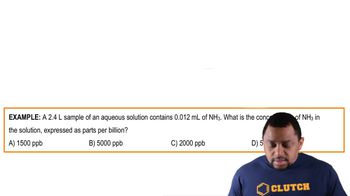
Parts per Billion Example
3437
views
17
rank
Guided course
01:38
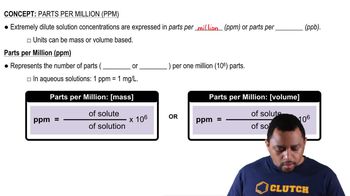
Parts per Million (ppm)
5638
views
30
rank
Terms in this set (15)
Hide definitions
What does 'parts per million' (ppm) represent in solution concentration?
Ppm represents the number of parts, either in grams or milliliters, per one million parts of solution.
How is 1 ppm related to milligrams and liters in aqueous solutions?
1 ppm is equivalent to 1 milligram of solute per 1 liter of solution.
What is the formula for ppm in terms of mass?
Ppm (mass) = grams of solute divided by grams of solution, multiplied by 10^6.
How do you calculate ppm using volume?
Ppm (volume) = milliliters of solute divided by milliliters of solution, multiplied by 10^6.
What is the abbreviation for parts per million?
Parts per million is abbreviated as ppm.
What is the value of one million in scientific notation?
One million is written as 10^6.
What is the main use of ppm and ppb in chemistry?
They are used to express extremely dilute solution concentrations.
How does the calculation for ppm resemble mass percent?
Both use grams of solute over grams of solution, but ppm multiplies by 10^6 instead of 100%.
What does 'parts per billion' (ppb) represent?
Ppb represents the number of parts, either in grams or milliliters, per one billion parts of solution.
How is 1 ppb related to micrograms and liters in aqueous solutions?
1 ppb is equivalent to 1 microgram of solute per 1 liter of solution.
What is the formula for ppb in terms of mass?
Ppb (mass) = grams of solute divided by grams of solution, multiplied by 10^9.
How do you calculate ppb using volume?
Ppb (volume) = milliliters of solute divided by milliliters of solution, multiplied by 10^9.
What is the abbreviation for parts per billion?
Parts per billion is abbreviated as ppb.
What is the value of one billion in scientific notation?
One billion is written as 10^9.
Why are ppm and ppb important in aqueous solutions?
They are crucial for expressing concentration when dealing with very low quantities of solute.
 BackBack
 01:11
01:11