General Chemistry
My Course
Learn
Exam Prep
AI Tutor
Study Guides
Textbook Solutions
Flashcards
Explore
My Course
Learn
Exam Prep
AI Tutor
Study Guides
Textbook Solutions
Flashcards
Explore
Back
Quantum Numbers: Angular Momentum Quantum Number quiz #1
You can tap to flip the card.
Which characteristic is determined by the angular momentum quantum number (l)?
You can tap to
flip the card.
👆
Which characteristic is determined by the angular momentum quantum number (l)?
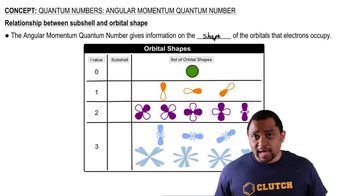
The angular momentum quantum number (l) determines the shape of an atom's orbital.
Track progress
Control buttons has been changed to "navigation" mode.
1/33
Related flashcards
Related practice
Recommended videos
Guided course
00:40
Angular Momentum Quantum Number
Jules
5065
views
26
rank
Guided course
00:46
Angular Momentum Quantum Number Example
Jules
3990
views
28
rank
Guided course
01:02
Angular Momentum Quantum Number and Subshell
Jules
3891
views
15
rank
1
comments
Terms in this set (33)
Hide definitions
Which characteristic is determined by the angular momentum quantum number (l)?
The angular momentum quantum number (l) determines the shape of an atom's orbital.
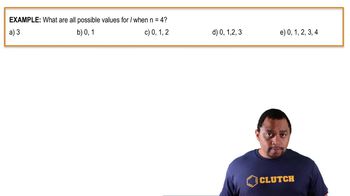
Which of the following gives the correct possible values of l for n = 4?
The possible values of l for n = 4 are 0, 1, 2, and 3.
How many orbitals are allowed in the subshell when l = 2?
When l = 2 (d subshell), there are 5 orbitals allowed.
In a ground state atom of krypton (Kr), how many electrons total will have the quantum number l = 2?
In a ground state Kr atom, 10 electrons have l = 2 (from the 3d and 4d subshells, but only 3d is filled, so 10 electrons in 3d).
In a ground state atom of argon (Ar), how many electrons total will have the quantum number l = 0?
In a ground state Ar atom, 6 electrons have l = 0 (from the 1s, 2s, and 3s subshells: 2 each).
How many different values of l are possible for an electron with principal quantum number n = 5?
For n = 5, there are 5 possible values of l: 0, 1, 2, 3, and 4.
Which quantum number does not give information about an individual orbital?
The principal quantum number (n) does not give information about an individual orbital; it specifies the energy level.
How many possible combinations are there for the values of l and ml when n = 3?
For n = 3, there are 9 possible combinations of l and ml.
How many orbitals can have quantum numbers of n = 2 and l = 1?
For n = 2 and l = 1 (2p subshell), there are 3 orbitals.
What is the maximum number of p orbitals that are possible in a given shell?
There are 3 p orbitals possible in a given shell.
What are the possible values of l if n = 5?
The possible values of l for n = 5 are 0, 1, 2, 3, and 4.
Which of the following quantum numbers describes the shape of an orbital?
The angular momentum quantum number (l) describes the shape of an orbital.
For which atomic orbital does n = 3 and l = 1?
n = 3 and l = 1 corresponds to the 3p orbital.
What quantum numbers specify these subshells? (For example, 2p, 3d, 4f.)
Each subshell is specified by n (principal quantum number) and l (angular momentum quantum number): s (l=0), p (l=1), d (l=2), f (l=3).
Which of the following represent impossible combinations of n and l?
Any combination where l is not in the range 0 to n-1 is impossible (e.g., n = 2, l = 2 is impossible).
What are the possible values of l if n = 4?
The possible values of l for n = 4 are 0, 1, 2, and 3.
What are the possible values of the angular momentum quantum number l?
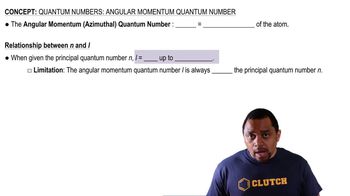
For a given n, l can be any integer from 0 up to n-1.
What are the possible values of l for each of the following values of n?
For n = 1: l = 0; for n = 2: l = 0, 1; for n = 3: l = 0, 1, 2; for n = 4: l = 0, 1, 2, 3.
How many values of the quantum number l are possible when n = 5?
There are 5 possible values of l when n = 5: 0, 1, 2, 3, and 4.
How many different values of l are possible in the third principal level?
In the third principal level (n = 3), there are 3 possible values of l: 0, 1, and 2.
What are the allowed values for the angular momentum quantum number l?
The allowed values for l are integers from 0 up to n-1 for a given n.
What does the angular momentum quantum number determine?
The angular momentum quantum number determines the shape of the orbital.
How many possible combinations are there for the values of l and ml when n = 4?
For n = 4, there are 16 possible combinations of l and ml.
What type of orbital is occupied by an electron with n = 3 and l = 2?
An electron with n = 3 and l = 2 occupies a 3d orbital.
How many different spatial orientations are there for f orbitals (l = 3)?
There are 7 different spatial orientations for f orbitals (l = 3).
What is the full range of possible values of l for n = 3?
For n = 3, the possible values of l are 0, 1, and 2.
How many p orbitals exist in one energy level (n ≥ 2) of an atom?
There are 3 p orbitals in any energy level where n ≥ 2.
Which subshell letter corresponds to a spherical orbital?
The s subshell (l = 0) corresponds to a spherical orbital.
What are the allowed values of l when the principal quantum number is n = 5?
The allowed values of l for n = 5 are 0, 1, 2, 3, and 4.
What does the angular momentum quantum number determine in a hydrogen atom?
In a hydrogen atom, the angular momentum quantum number determines the shape of the orbital.
What is the correct representation for the subshell with n = 2 and l = 1?
The correct representation is 2p.
What is the correct representation for the subshell with n = 2 and l = 1?
The correct representation is 2p.
What quantum numbers specify these subshells? (For example, 2p, 3d, 4f.)
Each subshell is specified by n (principal quantum number) and l (angular momentum quantum number): s (l=0), p (l=1), d (l=2), f (l=3).