Back

Rate Law quiz

Control buttons has been changed to "navigation" mode.
1/15
  • What does the rate law relate in a chemical reaction?

    The rate law relates the rate of a reaction to the concentrations of reactants, the rate constant, and the reaction orders.
  • What is the role of the rate constant (k) in the rate law?

    The rate constant (k) is a proportionality constant that links the reaction rate to the reactant concentrations and reaction orders.
  • How are reaction orders represented in the rate law expression?

    Reaction orders are the exponents applied to the reactant concentrations in the rate law expression.
  • How are reaction orders determined?

    Reaction orders are determined experimentally using data tables or by analyzing the reaction mechanism.
  • Does the rate law include product concentrations?

    No, the rate law only includes reactant concentrations and ignores product concentrations.
  • What is the general form of the rate law for a reaction with reactants A and B?

    The general form is rate = k[A]^x[B]^y, where x and y are the reaction orders for A and B.
  • What does the overall order of a reaction represent?

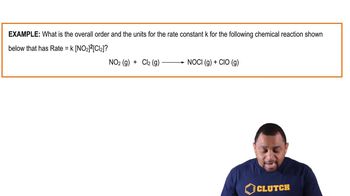
    The overall order is the sum of all individual reaction orders in the rate law.
  • How do you calculate the units for the rate constant (k)?

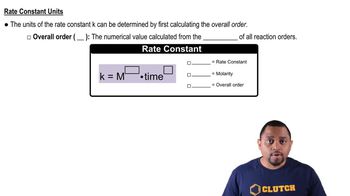
    First, determine the overall order (n), then use the formula k = M^(1-n)·time^(-1) to find the units.
  • What is the first step when solving rate law problems with given concentrations and initial rates?

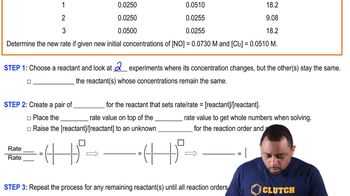
    The first step is to determine the reaction orders from the provided data.
  • Why can't you calculate the rate constant (k) before finding reaction orders?

    Because the value of k depends on the reaction orders, which must be determined first.
  • What sequence should you follow to solve for a new rate in rate law problems?

    First, find the reaction orders, then calculate the rate constant (k), and finally determine the new rate.
  • What does the variable 'n' represent in the formula for the units of k?

    'n' represents the overall order of the reaction, which is the sum of all reaction orders.
  • If a reaction has three reactants, how is the rate law written?

    The rate law would include all three reactants, for example: rate = k[A]^x[B]^y[C]^z.
  • What information do you need to determine the rate law experimentally?

    You need the concentrations of reactants and the initial rates of the reaction.
  • Why is it important to follow the correct sequence when solving rate law problems?

    Following the correct sequence ensures accurate determination of reaction orders, the rate constant, and the reaction rate.