Back

Intro to Chemical Kinetics quiz

Control buttons has been changed to "navigation" mode.
1/15
  • What does chemical kinetics study?

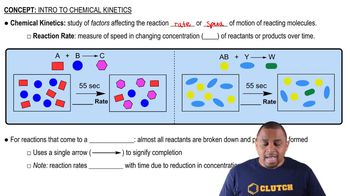
    Chemical kinetics studies the factors that affect the rate or speed at which reactants are converted into products.
  • How is reaction rate defined in chemical kinetics?

    Reaction rate is defined as the change in concentration of reactants or products over time.
  • What does it mean when a chemical species is shown in brackets, like [A]?

    Brackets around a chemical species indicate its concentration in the reaction.
  • How can you tell if a reaction has a faster rate compared to another?

    A reaction has a faster rate if it produces more product in the same amount of time compared to another reaction.
  • What does a single arrow in a chemical equation indicate about the reaction?

    A single arrow indicates that the reaction goes to completion, meaning nearly all reactants are converted into products.
  • What happens to the reaction rate as the concentration of reactants decreases?

    The reaction rate decreases as the concentration of reactants decreases.
  • Why can't a reaction continue forever?

    A reaction can't continue forever because eventually all the reactants are used up, stopping the reaction.
  • What sets the limit on how much product can be formed in a reaction?

    The amount of reactant available sets the limit on how much product can be formed.
  • In the example given, what indicated that reaction 1 was faster than reaction 2?

    Reaction 1 produced more product in 55 seconds compared to reaction 2, indicating a faster rate.
  • What must happen to reactants in order to form products?

    Reactants must be broken down in order to form products.
  • If only a small amount of product forms in a given time, what does this say about the reaction rate?

    It indicates that the reaction rate is slow.
  • What is the relationship between the amount of reactant transformed and the reaction rate?

    A greater amount of reactant transformed into product in a given time means a faster reaction rate.
  • What happens to the reaction rate as the reaction progresses and reactants are consumed?

    The reaction rate slows down as reactants are consumed.
  • Why is understanding reaction rates important in chemistry?

    Understanding reaction rates is crucial for predicting how chemical processes will progress under various conditions.
  • What does it mean for a reaction to go to completion?

    It means that almost all the reactants are converted into products by the end of the reaction.