Back

Reaction Mechanism quiz

Control buttons has been changed to "navigation" mode.
1/15
  • What is a reaction mechanism in chemistry?

    A reaction mechanism is a step-by-step sequence of elementary steps that describes how an overall chemical change occurs at the molecular level.
  • What is an elementary step in a reaction mechanism?

    An elementary step is a single event in a series of reactions that shows the progress of a reaction at the molecular level.
  • How do you determine the overall reaction from a reaction mechanism?

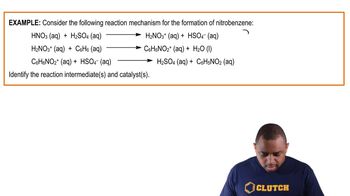
    You determine the overall reaction by canceling out catalysts and reaction intermediates from the sequence of elementary steps.
  • What is a catalyst in the context of a reaction mechanism?

    A catalyst is a compound that appears as a reactant in the first step and as a product in the final step of the mechanism.
  • What is a reaction intermediate?

    A reaction intermediate is a compound that first appears as a product in one elementary step and later as a reactant in another step.
  • How do you identify the molecularity of an elementary step?

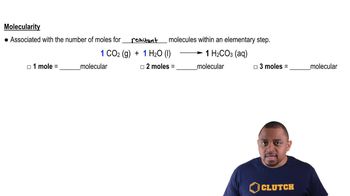
    Molecularity is determined by counting the total number of reactant molecules in an elementary step.
  • What is a unimolecular elementary step?

    A unimolecular step involves only one reactant molecule.
  • What is a bimolecular elementary step?

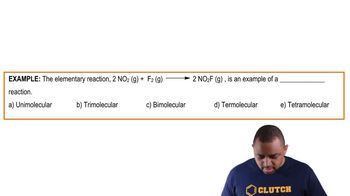
    A bimolecular step involves two reactant molecules.
  • What is a termolecular elementary step?

    A termolecular step involves three reactant molecules.
  • What is the rate-determining step in a reaction mechanism?

    The rate-determining step is the slowest elementary step in the mechanism, which limits the overall rate of the reaction.
  • How are the reaction orders in the rate law related to the rate-determining step?

    The coefficients of the reactants in the rate-determining step correspond to the reaction orders in the rate law.
  • What happens to catalysts and intermediates when writing the overall reaction?

    Catalysts and intermediates are canceled out, and only the remaining species are included in the overall reaction.
  • Why is the rate-determining step important in kinetics?

    It dictates the overall reaction rate because the reaction cannot proceed faster than its slowest step.
  • What prefix is used for two reactant molecules in molecularity, and why?

    The prefix 'bi-' is used for two reactant molecules, not 'di-', so the step is called bimolecular.
  • What prefix is used for three reactant molecules in molecularity?

    The prefix 'ter-' is used, so the step is called termolecular, not trimolecular.