Back

Stoichiometric Rate Calculations quiz

Control buttons has been changed to "navigation" mode.
1/15
  • What is a stoichiometric rate calculation?

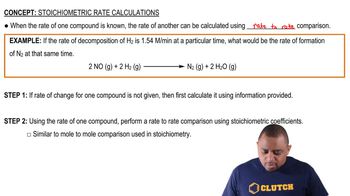
    It is a calculation where the rate of one compound is used to determine the rate of another compound using stoichiometric coefficients from a balanced chemical equation.
  • How do you determine the rate of formation of a compound if the rate of decomposition of another is known?

    You use a rate-to-rate comparison based on the stoichiometric coefficients in the balanced equation.
  • What is the first step in stoichiometric rate calculations if the rate of change for a compound is not given?

    First, calculate the rate of change for the compound using the information provided.
  • What is the second step in stoichiometric rate calculations?

    Perform a rate-to-rate comparison using the stoichiometric coefficients from the balanced chemical equation.
  • How is a rate-to-rate comparison similar to a mole-to-mole comparison?

    Both use stoichiometric coefficients to relate quantities of different compounds, but rate-to-rate compares rates instead of moles.
  • If the rate of decomposition of H2 is 1.54 mol/L per minute, what is the rate of formation of N2 given a 2:1 ratio?

    The rate of formation of N2 is 0.770 mol/L per minute, which is half the rate of H2 due to the 2:1 stoichiometric ratio.
  • What do stoichiometric coefficients represent in rate calculations?

    They represent the relative rates at which compounds are consumed or produced in a reaction.
  • How do you set up a rate-to-rate comparison using stoichiometric coefficients?

    Multiply the known rate by the ratio of the coefficients for the desired compound to the known compound.
  • What units are typically used in stoichiometric rate calculations?

    Rates are usually expressed in mol/L per minute or similar concentration/time units.
  • Why do the units cancel out in a rate-to-rate comparison?

    Because you are comparing rates with the same units, allowing you to focus on the stoichiometric ratio.
  • What is a key giveaway that you are dealing with a stoichiometric rate calculation?

    You are given the rate of one compound and asked for the rate of another within a balanced chemical equation.
  • Can you find the rate of any compound in a reaction if you know the rate of another?

    Yes, by using the stoichiometric coefficients and performing a rate-to-rate comparison.
  • What is the balanced chemical equation used for in stoichiometric rate calculations?

    It provides the stoichiometric coefficients needed to relate the rates of different compounds.
  • What happens if the stoichiometric coefficient for H2 is 2 and for N2 is 1?

    H2 decomposes twice as fast as N2 forms, so the rate of N2 formation is half the rate of H2 decomposition.
  • What principle allows you to find the rate of any compound in a reaction?

    The principle of stoichiometry applied to reaction rates, using the balanced equation's coefficients.