What is the mole ratio of hydrogen gas (H₂) to ammonia (NH₃) in the balanced chemical equation for ammonia synthesis?
In the balanced equation for ammonia synthesis (N₂ + 3H₂ → 2NH₃), the mole ratio of hydrogen gas (H₂) to ammonia (NH₃) is 3:2.
What is the mole ratio of ammonia (NH₃) to nitrogen gas (N₂) in the balanced chemical equation for ammonia synthesis?
In the balanced equation for ammonia synthesis (N₂ + 3H₂ → 2NH₃), the mole ratio of ammonia (NH₃) to nitrogen gas (N₂) is 2:1.
How do you determine the correct mole ratios between substances in a chemical reaction?
To determine the correct mole ratios, write and balance the chemical equation, then use the coefficients of each substance in the equation to set up the ratios between reactants and products.
What are the steps to find a mole ratio in a stoichiometry problem?
First, write and balance the chemical equation. Then, identify the substances of interest and use their coefficients from the balanced equation to set up the mole ratio.
Why is it essential to balance a chemical equation before performing stoichiometric calculations?
Balancing the equation ensures the correct mole ratios between reactants and products. Without a balanced equation, stoichiometric calculations would yield incorrect results.
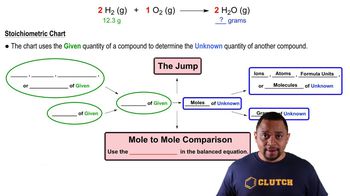
What is the purpose of the 'jump' or 'leap of faith' in the stoichiometric chart?
The 'jump' refers to moving from moles of the given substance to moles of the unknown substance using the balanced equation's coefficients. This step is crucial for relating the quantities of different substances in the reaction.
In stoichiometry, what types of quantities can be provided as the 'given information' in a problem?
The given information can be in grams, ions, atoms, formula units, or molecules of a substance. All these forms must be converted to moles before proceeding with stoichiometric calculations.
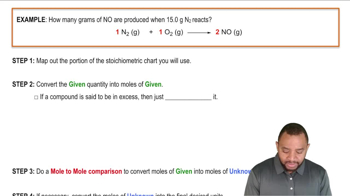
After converting grams of a reactant to moles, what is the next step in determining the amount of product formed?
The next step is to use the mole-to-mole ratio from the balanced equation to find moles of the unknown product. This ratio is determined by the coefficients in the balanced chemical equation.
What is the final step if a stoichiometry problem asks for the mass of a product rather than the number of moles?
After finding the moles of the unknown product, convert those moles to grams using the molar mass of the product. This gives the mass of the product formed in the reaction.
How does the stoichiometric chart help in solving stoichiometry problems?
The chart visually guides the conversion path from the given information to the unknown quantity. It ensures each necessary step—such as converting to moles and applying mole ratios—is followed systematically.