Pearson+ LogoPearson+ Logo

Subatomic Particles quiz #6 Flashcards

Subatomic Particles quiz #6
Control buttons has been changed to "navigation" mode.
1/40
  • Which subatomic particle has the least amount of mass?

    The electron has the least amount of mass.
  • Which subatomic particle was discovered first?

    The electron was the first subatomic particle discovered.
  • Which of these is not found in the nucleus of an atom?

    Electrons are not found in the nucleus.
  • How many neutrons does an atom of carbon have?

    A carbon-12 atom has 6 neutrons.
  • What are the three major subatomic particles that make up an atom?

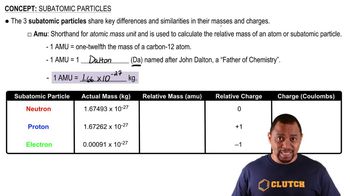
    Protons, neutrons, and electrons.
  • Which part of an atom has a negative charge?

    The electron cloud has a negative charge.
  • Which particle has the least mass?

    The electron has the least mass.
  • Which particle has a positive charge?

    The proton has a positive charge.
  • Which part of the atom has a negative charge?

    The electron cloud has a negative charge.
  • Which particle (if any) is neutral?

    The neutron is neutral.
  • Which part of the atom has a positive charge?

    The nucleus has a positive charge due to protons.
  • Which nuclear emission has the greatest mass?

    Alpha particles have the greatest mass among nuclear emissions.
  • Which nuclear emission has the greatest mass?

    Alpha particles have the greatest mass among nuclear emissions.
  • What part of an atom has a negative charge?

    The electron cloud has a negative charge.
  • Which part of an atom has a positive charge?

    The nucleus has a positive charge due to protons.
  • Which particles have a negative charge?

    Electrons have a negative charge.
  • Which particle does not affect the charge?

    Neutrons do not affect the charge.
  • What is one way neutrons are different from electrons?

    Neutrons are neutral and found in the nucleus; electrons are negatively charged and orbit the nucleus.
  • Which particles are not affected by the strong force?

    Electrons are not affected by the strong nuclear force.
  • Neutrons have which type of electrical charge?

    Neutrons have no electrical charge.
  • Which of the following subatomic particles has appreciable mass and lacks a charge?

    The neutron has appreciable mass and lacks a charge.
  • Which subatomic particle is most movable in an atom and can occupy an orbital?

    Electrons are the most movable and occupy orbitals.
  • Which particle has a negative charge?

    The electron has a negative charge.
  • Which symbol represents a particle that has a mass approximately equal to the mass of a neutron?

    n⁰ represents a neutron, which has a mass about equal to a proton.
  • What is the charge of a proton?

    A proton has a positive charge (+1).
  • How are electrons different from protons and neutrons?

    Electrons are much lighter and have a negative charge; protons and neutrons are heavier and found in the nucleus.
  • Which particle is J. J. Thomson credited with discovering: electron, neutron, proton, or photon?

    J.J. Thomson is credited with discovering the electron.
  • What subatomic particle acts like a mini-magnet?

    The electron acts like a mini-magnet due to its spin and charge.
  • Which statement describes the location of two types of subatomic particles in a helium atom?

    Protons and neutrons are in the nucleus; electrons orbit the nucleus.
  • What type of particle has no mass or charge: alpha, beta, gamma, or proton?

    Gamma particles (photons) have no mass or charge.
  • Which particle is J. J. Thomson credited with discovering: electron, neutron, proton, photon?

    J.J. Thomson is credited with discovering the electron.
  • What part of an atom is involved in a chemical reaction: proton, neutron, nucleus, electron?

    Electrons are involved in chemical reactions.
  • Dispersion forces occur in all types of substances that contain which type of subatomic particle?

    Dispersion forces occur in substances that contain electrons.
  • Which subatomic particles are indicated by the orange circles in the diagram?

    The orange circles likely represent electrons.
  • Which particle has a positive (+) charge?

    The proton has a positive (+) charge.
  • A hydrogen ion (H+) has only one subatomic particle, a(n) ______.

    A hydrogen ion (H+) has only one proton.
  • When considering precise mass, which particle has the greatest mass?

    The neutron has the greatest mass among subatomic particles.
  • Which is a characteristic of the part of the atom marked 'b'?

    If 'b' marks the nucleus, it contains protons and neutrons and is positively charged.
  • Which statement correctly describes the location, charge, and mass of the neutrons in an atom?

    Neutrons are in the nucleus, have no charge, and a mass of about 1 amu.
  • Select the subatomic particles that combine to form atoms.

    Protons, neutrons, and electrons combine to form atoms.