Pearson+ LogoPearson+ Logo

Temperature quiz #4 Flashcards

Temperature quiz #4
Control buttons has been changed to "navigation" mode.
1/40
  • Which graph represents the system with the lowest temperature?

    The graph with the lowest average kinetic energy or slowest particle movement.
  • What causes the pointer of a dial thermometer to move?

    Thermal expansion of a metal coil or strip inside the thermometer.
  • Which of the following light sources measures around 3000 K (kelvin scale)?

    An incandescent light bulb.
  • What battery rating is tested at 32°F (0°C)?

    Cold cranking amps (CCA) for car batteries.
  • When a temperature gauge reads hot, what does it indicate?

    It indicates that the temperature is above the normal or safe operating range.
  • Which phrase correctly describes temperature?

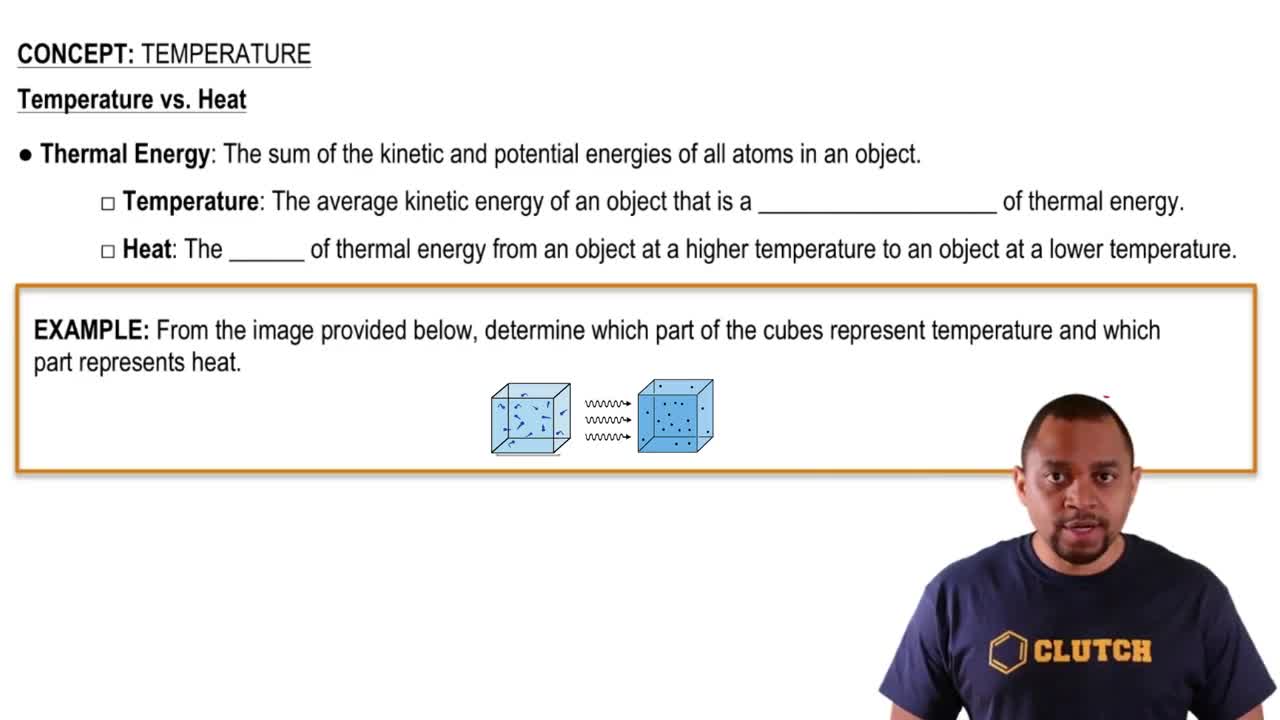
    Temperature is the average kinetic energy of the particles in a substance.
  • Which temperature in Celsius (°C) does this thermometer show? –8°, 0°, 25°, 32°

    The answer depends on the thermometer reading; for example, if it shows 0°, that is the freezing point of water.
  • Which thermocouple probe should be used to check the temperature of a large stockpot of soup?

    An immersion probe.
  • A substance is heated. Which of the following charts has true information?

    The chart showing increased temperature corresponds to increased average kinetic energy.
  • Which of the following is the temperature at which a given oil will begin to smoke?

    The smoke point of the oil.
  • How does a sample of water at 38°C compare to a sample of water at 295 K?

    38°C (311.15 K) is warmer than 295 K (21.85°C).
  • Which of the following is true of temperature? Responses

    Temperature is an intensive property and measures average kinetic energy.
  • Which of the following would you use to measure the temperature of oil for deep frying?

    A thermometer designed for high temperatures, such as a deep-fry or candy thermometer.
  • At which temperature does the motion of atoms and molecules stop?

    At absolute zero (0 K, –273.15°C).
  • Which one of these cites the lowest temperature?

    The value closest to absolute zero is the lowest temperature.
  • Temperature is a measure of the average energy of particles in a substance.

    True.
  • Temperature is the variable and the amount of sugar in the solution is the variable.

    Temperature is an independent variable; amount of sugar is a dependent variable in an experiment.
  • Measure of the average kinetic energy of all the particles in a substance.

    Temperature.
  • In degrees Fahrenheit, what is the temperature range of the danger zone?

    40°F to 140°F.
  • What does temperature measure?

    The average kinetic energy of the particles in a substance.
  • 37.6°C to °F

    99.7°F.
  • 36.9°C to °F

    98.4°F.
  • 36.6°C to °F

    97.9°F.
  • 39.1°C to °F

    102.4°F.
  • F = (9/5 × C) + 32

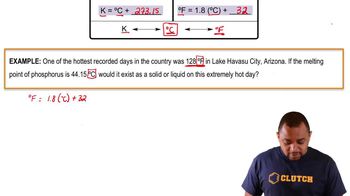
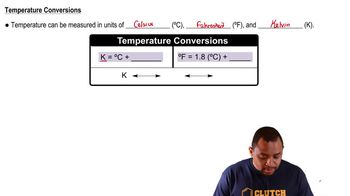
    This is the formula to convert Celsius to Fahrenheit.
  • 99.6°F to °C

    37.6°C.
  • 38.6°C to °F

    101.5°F.
  • When should a bimetal stemmed or digital thermometer be calibrated?

    Before first use and regularly, especially after being dropped or exposed to extreme temperatures.
  • 68°F to °C

    20°C.
  • 99.3°F to °C

    37.4°C.
  • The temperature of the water is about 5°C, while the temperature of the air is about 21°C.

    The air is warmer than the water; molecules in the air move faster.
  • 106°F to °C

    41.1°C.
  • What happens to the particles in a substance when the temperature rises?

    They move faster as their kinetic energy increases.
  • 45°F to °C

    7.2°C.
  • 46°C to Fahrenheit

    114.8°F.
  • Why is –40 degrees Fahrenheit the same as Celsius?

    Because –40°F and –40°C are the point where the two temperature scales intersect.
  • 160°C to Fahrenheit

    320°F.
  • 98°F to °C

    36.7°C.
  • Where should you check the temperature of a refrigerated green smoothie?

    In the center of the smoothie, away from the container walls.
  • What does the term temperature control refer to?

    Maintaining substances within a safe or desired temperature range.