Back

The Atom quiz

Control buttons has been changed to "navigation" mode.
1/15
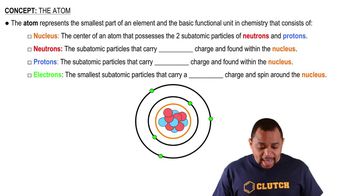
  • What are the four primary parts of the atom discussed in general chemistry?

    The four primary parts are the nucleus, protons, neutrons, and electrons.
  • Where are protons and neutrons located within the atom?

    Protons and neutrons are located in the nucleus at the center of the atom.
  • What charge do protons carry?

    Protons carry a positive charge.
  • What is the charge of neutrons?

    Neutrons have no charge; they are neutral.
  • Where are electrons found in the atom?

    Electrons are found spinning around the nucleus.
  • What charge do electrons have?

    Electrons have a negative charge.
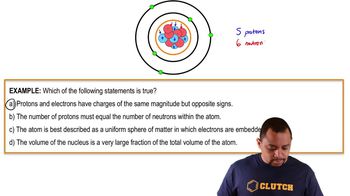
  • How does the size of the nucleus compare to the total volume of the atom?

    The nucleus is extremely small relative to the total volume of the atom.
  • What is the function of neutrons in the nucleus?

    Neutrons act as the glue that helps keep the positively charged protons together in the nucleus.
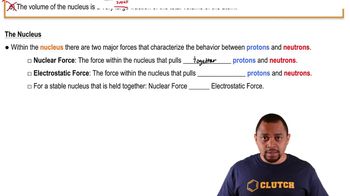
  • What is the nuclear force?

    The nuclear force is the force within the nucleus that pulls together protons and neutrons.
  • What is the electrostatic force in the context of the nucleus?

    The electrostatic force is the force that tries to pull apart protons and neutrons in the nucleus.
  • Why do protons in the nucleus repel each other?

    Protons repel each other because they all have the same positive charge.
  • What must be true for a nucleus to be stable?

    For a nucleus to be stable, the nuclear force must be greater than the electrostatic force.
  • What happens if the electrostatic force is greater than the nuclear force in the nucleus?

    If the electrostatic force is greater, the nucleus can break down and be destroyed.
  • Why are neutrons important for the stability of the nucleus?

    Neutrons help offset the repulsion between protons, acting as a stabilizing 'glue' in the nucleus.
  • What is the basic functional unit in chemistry?

    The atom is the basic functional unit in chemistry.