Pearson+ LogoPearson+ Logo

The Atom quiz #20 Flashcards

The Atom quiz #20
Control buttons has been changed to "navigation" mode.
1/40
  • What atomic particles move from one surface to another in order to form a static charge?

    Electrons move to form a static charge.
  • What is a molecule?

    A molecule is a group of two or more atoms bonded together.
  • The reactivity of an atom arises from what?

    The reactivity of an atom arises from its valence electrons.
  • Which is a characteristic of the part of the atom marked 'a'?

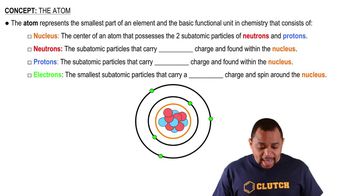
    'a' typically marks the nucleus, which is dense and positively charged.
  • The reactivity of an atom arises from __________.

    The reactivity of an atom arises from its valence electrons.
  • When the proton number and electron number are unequal, the atom or molecule __________.

    It becomes an ion with a net electric charge.
  • All atoms of the element vanadium must have the same what?

    All vanadium atoms have the same number of protons (23).
  • The smallest part of an element that still retains the properties of that element is called a(n) what?

    It is called an atom.
  • The smallest particle of an element that retains the properties of that element is a(n) ____.

    It is an atom.
  • The atomic number of magnesium is 12. This means that its nucleus must contain what?

    Magnesium's nucleus contains 12 protons.
  • All phosphorus atoms have the same what?

    All phosphorus atoms have the same number of protons (15).
  • Neon is a gas made up of only one type of atom. Which term best describes neon?

    Neon is an element.
  • Chemists assign atoms to chemical elements by counting their what?

    Chemists count the number of protons in the atom.
  • An atom would become a different element if which characteristic changed?

    If the number of protons changed, the atom would become a different element.
  • A spherical electron cloud surrounding an atomic nucleus would best represent what?

    It represents the region where electrons are likely to be found.
  • If two atoms have the same number of protons in their nucleus, you can conclude for sure that they what?

    They are atoms of the same element.
  • The chemical behavior of an atom is determined by the number and configuration of its what?

    The chemical behavior is determined by its electrons, especially valence electrons.
  • Which statement describes the atoms?

    Atoms are the smallest units of elements, with a nucleus and electrons.
  • The superscript preceding each hydrogen atomic symbol (H) represents which of the following?

    It represents the mass number (protons plus neutrons).
  • Phosphorus-33 (atomic number 15) contains what?

    Phosphorus-33 has 15 protons and 18 neutrons.
  • Which particles zoom around the center of atoms: electrons, protons, neutrons, or all of the above?

    Electrons zoom around the center of atoms.
  • Identify the atom whose nucleus is composed of 56 protons and 82 neutrons.

    Barium (Ba) has 56 protons and 82 neutrons.
  • Ag-109 has 62 neutrons. The neutral atom has how many protons?

    Silver (Ag) has 47 protons.
  • An atom that normally has in its outer shell would not form chemical bonds with other atoms.

    An atom with a full outer shell would not form chemical bonds.
  • What is the charge of an atom with 15 protons, 16 neutrons, and 17 electrons?

    The atom has a charge of โ€“2 (more electrons than protons).
  • 86 electrons, 125 neutrons, 82 protons: what element is this?

    This is a neutral lead (Pb) atom with mass number 207.
  • Compared to an atom as a whole, an atomic nucleus is what?

    The nucleus is much smaller and denser than the atom as a whole.
  • Water molecules are made of hydrogen atom(s) and oxygen atom(s). (use only one number per blank.)

    Water molecules are made of 2 hydrogen atoms and 1 oxygen atom.
  • The ozone layer absorbs most of the incoming _____ radiation.

    The ozone layer absorbs most ultraviolet (UV) radiation.
  • Atoms seldom exist as independent particles in nature because why?

    Atoms tend to bond with other atoms to form molecules or compounds.
  • Which is a characteristic of the part of the atom marked 'a'?

    'a' typically marks the nucleus, which is dense and positively charged.
  • The form of oxygen that combines three oxygen atoms into each molecule is called what?

    It is called ozone (O3).
  • The most abundant element in air. Hint: it has an atomic number of 7.

    Nitrogen is the most abundant element in air.
  • A certain atom has 26 protons, 26 electrons, and 30 neutrons. Its mass number is ____.

    Its mass number is 56 (26 protons + 30 neutrons).
  • Calcium has an atomic number of 20 and an atomic mass of 40. Therefore, a calcium atom must have what?

    Calcium has 20 protons, 20 electrons, and 20 neutrons.
  • The chemical characteristics or reactivity of an element depend mostly on the what?

    They depend mostly on the number of valence electrons.
  • A neutral atom of aluminum-27 contains what?

    Aluminum-27 has 13 protons, 14 neutrons, and 13 electrons.
  • Atoms of a specific element always have a constant number of _____.

    Atoms of a specific element always have a constant number of protons.
  • Reactivity of an atom arises from what?

    Reactivity arises from the number and arrangement of valence electrons.
  • The atomic number of sulfur is 16, which indicates that a sulfur atom contains what?

    Sulfur contains 16 protons.