The Electron Configuration quiz #9 Flashcards

The Electron Configuration quiz #9
Control buttons has been changed to "navigation" mode.
1/40
  • Which electron configuration represents an excited state?

    A configuration with electrons in higher orbitals than expected.
  • Use the periodic table to write the electron configuration of selenium (Se).

    Selenium: [Ar]4s2 3d10 4p4.
  • Co3+ electron configuration

    Co3+: [Ar]3d6.
  • A monochromatic laser is exciting hydrogen atoms from the n=2 state to the n=5 state.

    Electrons absorb energy and move from n=2 to n=5.
  • Which element has the ground state electronic configuration, 1s2 2s2 2p6 3s2 3p6 4s1?

    Potassium (K).
  • Which element has the ground state electron configuration, 1s2 2s2 2p6 3s2 3p6 4s1?

    Potassium (K).
  • Which ground-state atom has an electron configuration described by the following orbital diagram?

    Provide the diagram to identify the atom.
  • In a multi-electron atom, which orbital will have the highest energy?

    The orbital with the highest principal quantum number and sublevel (e.g., 7p).
  • Draw the electron configuration for a neutral atom of vanadium.

    Vanadium: 1s2 2s2 2p6 3s2 3p6 4s2 3d3.
  • Partial energy level diagram for hydrogen

    Hydrogen: 1s1; higher levels are empty in ground state.
  • Draw the electron configuration for a neutral atom of zinc.

    Zinc: 1s2 2s2 2p6 3s2 3p6 4s2 3d10.
  • Draw the electron configuration for a neutral atom of iron.

    Iron: 1s2 2s2 2p6 3s2 3p6 4s2 3d6.
  • Draw the electron configuration for a neutral atom of manganese.

    Manganese: 1s2 2s2 2p6 3s2 3p6 4s2 3d5.
  • Orbital diagram for nickel

    Nickel: 1s (↑↓), 2s (↑↓), 2p (↑↓ ↑↓ ↑↓), 3s (↑↓), 3p (↑↓ ↑↓ ↑↓), 4s (↑↓), 3d (↑↓ ↑↓ ↑↓ ↑↓ ↑↓ ↑).
  • Ba2+ electron configuration

    Ba2+: [Xe].
  • Draw the electron configuration for a neutral atom of cobalt.

    Cobalt: 1s2 2s2 2p6 3s2 3p6 4s2 3d7.
  • Draw the electron configuration for a neutral atom of titanium.

    Titanium: 1s2 2s2 2p6 3s2 3p6 4s2 3d2.
  • Se2- electron configuration

    Se2-: [Ar]4s2 3d10 4p6.
  • P3- electron configuration

    P3-: 1s2 2s2 2p6 3s2 3p6.
  • Vanadium electron configuration

    Vanadium: [Ar]4s2 3d3.
  • Draw the electron configuration for a neutral atom of oxygen.

    Oxygen: 1s2 2s2 2p4.
  • Orbital diagram for arsenic

    Arsenic: 1s (↑↓), 2s (↑↓), 2p (↑↓ ↑↓ ↑↓), 3s (↑↓), 3p (↑↓ ↑↓ ↑↓), 4s (↑↓), 3d (↑↓ ↑↓ ↑↓ ↑↓ ↑↓), 4p (↑ ↑ ↑).
  • Nitrogen electron configuration

    Nitrogen: 1s2 2s2 2p3.
  • V3+ electron configuration

    V3+: [Ar]3d2.
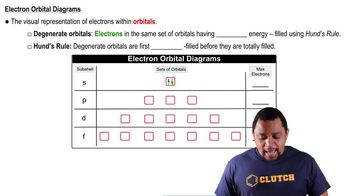
  • A pictorial representation of an electronic configuration is shown

    This is called an orbital diagram.
  • The electron configuration of a ground-state vanadium atom is

    Vanadium: [Ar]4s2 3d3.
  • Draw the electron configuration for a neutral atom of boron.

    Boron: 1s2 2s2 2p1.
  • Draw the electron configuration for a neutral atom of neon.

    Neon: 1s2 2s2 2p6.
  • 1s2 2s2 2p4 3s1

    An excited state of oxygen.
  • Draw the electron configuration for a neutral atom of nitrogen.

    Nitrogen: 1s2 2s2 2p3.
  • Draw the electron configuration for a neutral atom of magnesium.

    Magnesium: 1s2 2s2 2p6 3s2.
  • Te2- electron configuration

    Te2-: [Kr]5s2 4d10 5p6.
  • A neutral atom has the following electron configuration:

    Provide the configuration to identify the atom.
  • Ag+ electron configuration

    Ag+: [Kr]4d10.
  • NF ground state electron configuration

    NF is not a neutral atom; for nitrogen: 1s2 2s2 2p3.
  • Draw the electron configuration for a neutral atom of carbon.

    Carbon: 1s2 2s2 2p2.
  • Mn2+ electron configuration

    Mn2+: [Ar]3d5.
  • Y3+ electron configuration

    Y3+: [Kr].
  • Ge orbital diagram

    Germanium: 1s (↑↓), 2s (↑↓), 2p (↑↓ ↑↓ ↑↓), 3s (↑↓), 3p (↑↓ ↑↓ ↑↓), 4s (↑↓), 3d (↑↓ ↑↓ ↑↓ ↑↓ ↑↓), 4p (↑ ↑).
  • The ground state electron configuration of a Se atom is

    Selenium: [Ar]4s2 3d10 4p4.