Pearson+ LogoPearson+ Logo
Back

The Ideal Gas Law quiz #3

Control buttons has been changed to "navigation" mode.
1/10
  • Which types of gases behave most like an ideal gas according to the ideal gas law?

    Gases that behave most like an ideal gas are those at high temperature and low pressure, where intermolecular forces and the volume of gas particles are negligible. Under these conditions, real gases closely follow the ideal gas law (PV = nRT).
  • What are the units for pressure, volume, and temperature when using the ideal gas law?

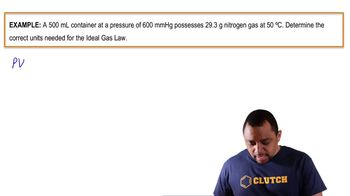
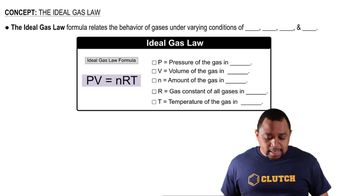
    Pressure is measured in atmospheres, volume in liters, and temperature in Kelvin. These units must be used to ensure the gas constant R is applied correctly.
  • What does the variable 'n' represent in the ideal gas law equation?

    The variable 'n' stands for the amount of gas measured in moles. It quantifies the number of particles present in the sample.
  • Why is it important to memorize the ideal gas law equation for chemistry courses?

    The ideal gas law equation is fundamental and frequently used in various calculations and concepts throughout the chapter. Professors expect students to know and apply it in different scenarios.
  • When should you use the gas constant R = 8.314 in calculations?

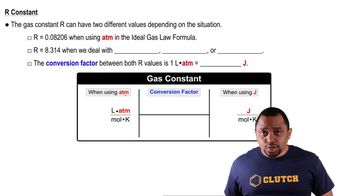
    You should use R = 8.314 when dealing with calculations involving speed, velocity, or energy. This value is expressed in units of J/(mol·K).
  • What is the conversion factor between liters·atmospheres and joules?

    The conversion factor is 1 L·atm equals 101.325 joules. This allows you to convert between the two units when necessary.
  • How do you convert the gas constant from L·atm/(mol·K) to J/(mol·K)?

    You multiply the value in L·atm/(mol·K) by the conversion factor 101.325 J per L·atm. This changes the units to J/(mol·K).
  • What happens to the units of liters·atmospheres when converting to joules using the conversion factor?

    Liters·atmospheres cancel out during the conversion, leaving the result in joules. This is essential for calculations involving energy.
  • Why do textbooks often round the gas constant R to 8.314 instead of using the full value?

    Textbooks round R to 8.314 for simplicity, even though the full calculated value is slightly longer. This makes calculations easier and more manageable for students.
  • In what types of problems is the ideal gas law most commonly applied?

    The ideal gas law is most commonly applied in problems involving the relationships between pressure, volume, temperature, and moles of a gas. It is a central equation for describing ideal gas behavior under various conditions.