Back

Triprotic Acids and Bases quiz

Control buttons has been changed to "navigation" mode.
1/15
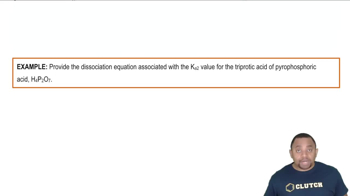
  • What is the general formula for a triprotic acid?

    The general formula for a triprotic acid is H3A.
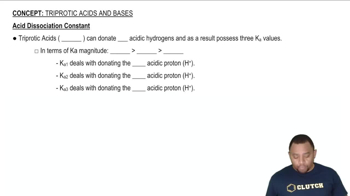
  • How many acidic hydrogens can a triprotic acid donate?

    A triprotic acid can donate three acidic hydrogens (protons).
  • What are the names of the three acid dissociation constants for a triprotic acid?

    The three acid dissociation constants are Ka1, Ka2, and Ka3.
  • Which Ka value is the largest for a triprotic acid and why?

    Ka1 is the largest because it is easiest to lose the first proton; each subsequent proton is harder to lose, making Ka2 and Ka3 smaller.
  • What does Ka1 represent in a triprotic acid?

    Ka1 represents the dissociation constant for the loss of the first acidic proton.
  • What is the relationship between Ka and Kb values for a triprotic acid?

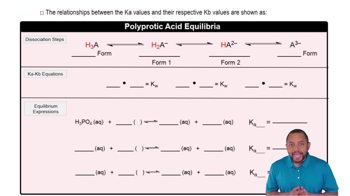
    Ka1 is related to Kb3, Ka2 to Kb2, and Ka3 to Kb1, with each pair multiplying to equal Kw.
  • How many different forms can a triprotic acid take as it loses protons?

    A triprotic acid can take four different forms as it loses protons.
  • What is the basic form of a triprotic acid after all protons are lost?

    The basic form is A3-, which has lost all three acidic protons.
  • What is the equilibrium expression for Ka1 of phosphoric acid?

    Ka1 = [H2PO4⁻][H3O⁺] / [H3PO4].
  • What is the equilibrium expression for Ka2 of phosphoric acid?

    Ka2 = [HPO4²⁻][H3O⁺] / [H2PO4⁻].
  • What is the equilibrium expression for Ka3 of phosphoric acid?

    Ka3 = [PO4³⁻][H3O⁺] / [HPO4²⁻].
  • What does Kb1 represent for the basic form of a triprotic acid?

    Kb1 represents the ability of the basic form (A3-) to accept the first proton.
  • What is the relationship between the product of a Ka and its corresponding Kb?

    The product of each Ka and its corresponding Kb equals Kw (the ion product constant for water).
  • What is a polyprotic acid, and how does it relate to triprotic acids?

    A polyprotic acid can donate more than one proton; a triprotic acid is a specific type with three protons to donate.
  • Why do the Ka values decrease with each proton lost in a triprotic acid?

    Each subsequent proton is harder to remove due to increasing negative charge, making the acid weaker and the Ka value smaller.