General Chemistry
My Course
Learn
Exam Prep
AI Tutor
Study Guides
Textbook Solutions
Flashcards
Explore
My Course
Learn
Exam Prep
AI Tutor
Study Guides
Textbook Solutions
Flashcards
Explore
Back
Valence Electrons of Elements quiz #5
You can tap to flip the card.
How many valence electrons does antimony have?
You can tap to
flip the card.
👆
How many valence electrons does antimony have?
Antimony has 5 valence electrons.
Track progress
Control buttons has been changed to "navigation" mode.
1/40
Related flashcards
Related practice
Recommended videos
Guided course
02:32
Main Group Elements Valence Electrons
Jules
3680
views
19
rank
2
comments
Guided course
01:14
Main Group Elements Valence Electrons Example
Jules
4867
views
34
rank
2
comments
Guided course
02:12
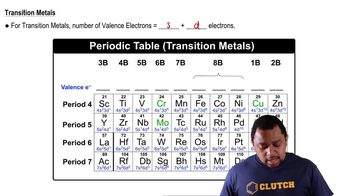
Transition Metals Valence Electrons
Jules
3770
views
12
rank
2
comments
Terms in this set (40)
Hide definitions
How many valence electrons does antimony have?
Antimony has 5 valence electrons.
How many valence electrons do barium and phosphorus have?
Barium has 2 valence electrons; phosphorus has 5.
How many valence electrons does iron have?
Iron has 8 valence electrons (6 in 3d and 2 in 4s).
In which principal energy level is/are the valence electron(s) found?
Valence electrons are found in the highest principal energy level occupied by electrons.
How many electrons can the 1st energy level hold?
The 1st energy level can hold 2 electrons.
Which of the following atoms has six valence electrons?
Oxygen, sulfur, and selenium each have six valence electrons.
How many valence electrons does tin have?
Tin has 4 valence electrons.
How many valence electrons does strontium have?
Strontium has 2 valence electrons.
How many valence electrons does Mg have?
Mg (magnesium) has 2 valence electrons.
How many valence electrons does strontium (Sr) have?
Strontium (Sr) has 2 valence electrons.
Which elements have valence electrons within the same energy level?
Elements in the same period have valence electrons in the same energy level.
How many electrons does bromine have?
Bromine has 35 electrons in total.
Which atoms could have an expanded valence shell?
Atoms from period 3 and beyond can have expanded valence shells.
How many valence electrons does C have?
C (carbon) has 4 valence electrons.
Why does it make sense for the valence electrons to increase going across a period?
Valence electrons increase across a period because each successive element adds one electron to the outer shell.
How many valence electrons does boron (B) have?
Boron (B) has 3 valence electrons.
How many valence electrons are there in an atom of neon?
Neon has 8 valence electrons.
Which of the following has eight valence electrons?
Noble gases (except helium) have eight valence electrons.
How many valence electrons are in a neutral atom of chlorine?
A neutral chlorine atom has 7 valence electrons.
How many valence electrons are in an atom of magnesium?
Magnesium has 2 valence electrons.
For the element arsenic: how many filled shells?
Arsenic has 4 filled electron shells.
Where are the electrons that are involved in bonding?
Electrons involved in bonding are the valence electrons in the outermost shell.
What part of the atom is involved in chemical bonding with other atoms?
Valence electrons are involved in chemical bonding.
What happens when nitrogen fills its valence shell?
Nitrogen achieves a stable octet and becomes chemically stable.
Which electrons in an atom will have the same amount of energy?
Electrons in the same shell (energy level) have similar energy.
How do valence electrons affect atoms?
Valence electrons determine an atom's chemical reactivity and bonding.
What is the most important factor in determining how an atom will bond?
The number and arrangement of valence electrons.
What can we learn by the number of electrons on the outer energy level of an atom?
We can predict the atom's chemical reactivity and bonding behavior.
What are the outermost electrons called?
The outermost electrons are called valence electrons.
Which of the following atoms or ions does not have a filled outer subshell?
Atoms or ions with less than 8 valence electrons do not have a filled outer subshell.
Which of the following atoms can expand its valence shell when bonding?
Atoms from period 3 and beyond (e.g., sulfur, phosphorus) can expand their valence shell.
What is the maximum number of electrons that can occupy each of the following subshells?
s: 2, p: 6, d: 10, f: 14 electrons.
What is a valence electron? Why are they important?
Valence electrons are outer shell electrons; they are important for chemical bonding and reactivity.
What is the maximum number of unpaired d electrons that an atom or ion can possess?
The maximum number of unpaired d electrons is 5.
How many more electrons does sulfur need to be stable?
Sulfur needs 2 more electrons to complete its octet.
How many valence electrons does the following atom have?
The number of valence electrons depends on the element's group number.
Which of the following elements has 8 valence electrons?
Noble gases (except helium) have 8 valence electrons.
How many electrons are in the outer (valence) shell of an Al³⁺ ion?
An Al³⁺ ion has no electrons in its outer shell.
How many unpaired electrons are there in each species below? Remember that Ti is a transition metal.
Titanium (Ti) has 2 unpaired electrons in its ground state.
How many electrons do most atoms seek to obtain in their valence shell?
Most atoms seek to obtain 8 electrons in their valence shell (octet rule).