Back

Valence Shell Electron Pair Repulsion Theory quiz

Control buttons has been changed to "navigation" mode.
1/15
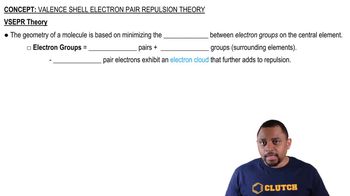
  • What does VSEPR theory state about the arrangement of electron groups around a central atom?

    VSEPR theory states that electron groups around a central atom arrange themselves to minimize repulsion.
  • What is considered an electron group in VSEPR theory?

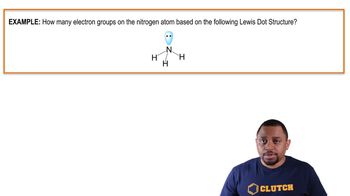
    An electron group is either a lone pair or a bonding group attached to the central atom.
  • How do lone pairs affect molecular geometry according to VSEPR theory?

    Lone pairs contribute additional repulsion due to their electron clouds, affecting the molecular shape.
  • What determines the possible molecular shapes in VSEPR theory?

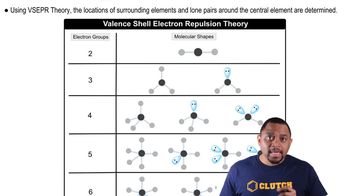
    The number of electron groups around the central atom determines the possible molecular shapes.
  • How many possible molecular shapes are there for a molecule with two electron groups?

    There is only one possible molecular shape for two electron groups.
  • How many possible molecular shapes can three electron groups produce?

    Three electron groups can produce two possible molecular shapes.
  • What are the possible arrangements for four electron groups around a central atom?

    Four electron groups can result in three shapes: all bonding groups, three bonding groups and one lone pair, or two bonding groups and two lone pairs.
  • How many different molecular shapes are possible with five electron groups?

    Five electron groups can produce four different molecular shapes.
  • What is the maximum number of molecular shapes possible for six electron groups?

    Six electron groups can result in three possible molecular shapes.
  • Why are lone pairs shown with a lobe in molecular shape diagrams?

    Lone pairs are shown with a lobe to represent their electron cloud, which causes extra repulsion.
  • What is a bonding group in the context of VSEPR theory?

    A bonding group refers to a surrounding element directly attached to the central atom.
  • How does the number of electron groups affect the complexity of molecular shapes?

    As the number of electron groups increases, the complexity and variety of possible molecular shapes also increase.
  • What is the relationship between electron group number and molecular shape limitation?

    The number of electron groups limits the types of molecular shapes a molecule can have.
  • How are the locations of surrounding elements and lone pairs determined in VSEPR theory?

    Their locations are determined by arranging them to minimize repulsion around the central atom.
  • Why are molecular shapes drawn in specific ways according to VSEPR theory?

    They are drawn to reflect the actual three-dimensional arrangements that minimize electron group repulsion.