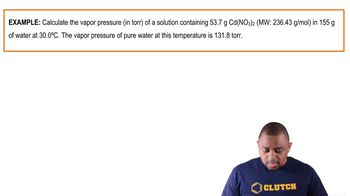
What is vapor pressure in the context of a liquid in a closed system?
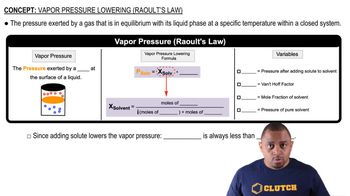
Vapor pressure is the pressure exerted by a gas that is in equilibrium with its liquid phase at a specific temperature within a closed system.
According to Raoult's law, what happens to the vapor pressure when a solute is added to a solvent?
The vapor pressure of the solution decreases compared to the pure solvent when a solute is added.
What is the formula for vapor pressure lowering according to Raoult's law?
P_solution = X_solvent × P°_solvent, where X_solvent is the mole fraction of the solvent and P°_solvent is the vapor pressure of the pure solvent.
In the formula for vapor pressure lowering, what does X_solvent represent?
X_solvent represents the mole fraction of the solvent in the solution.
What does the symbol P°_solvent indicate in Raoult's law?
P°_solvent indicates the vapor pressure of the pure solvent, with the degree sign showing it is pure.
What is the Van't Hoff factor (i) and how is it used in vapor pressure lowering calculations?
The Van't Hoff factor (i) represents the number of particles a solute dissociates into and is used to adjust the mole fraction calculation for ionic solutes.
Why is the vapor pressure of a solution always lower than that of the pure solvent?
The presence of solute particles reduces the number of solvent molecules at the surface, lowering the vapor pressure.
What physical processes are occurring at equal rates when vapor pressure is measured?
Condensation and vaporization are occurring at equal rates when vapor pressure is measured.
How do you calculate the mole fraction of the solvent in a solution containing a solute?
The mole fraction of the solvent is calculated as moles of solvent divided by (i × moles of solute + moles of solvent).
What is the effect of increasing the amount of solute on the vapor pressure of a solution?
Increasing the amount of solute further lowers the vapor pressure of the solution.
What is the relationship between the vapor pressure of a solution and the vapor pressure of the pure solvent?
The vapor pressure of a solution is always less than the vapor pressure of the pure solvent.
Why is it important to understand vapor pressure lowering when studying colligative properties?
Understanding vapor pressure lowering is crucial because it helps explain how solutes affect the physical properties of solutions, such as boiling point elevation and freezing point depression.
What does the term 'colligative properties' refer to?
Colligative properties are properties of solutions that depend on the number of solute particles, not their identity.
In the context of Raoult's law, why is the mole fraction of the solvent used instead of the solute?
The mole fraction of the solvent is used because vapor pressure depends on the proportion of solvent molecules at the surface.
What happens to the vapor pressure if a non-volatile solute is added to a solvent?
The vapor pressure decreases because the non-volatile solute does not contribute to the vapor phase, reducing the number of solvent molecules that can escape.
 Back
Back
 02:40
02:40