Skip to main content
General Chemistry
My Course
Learn
Exam Prep
AI Tutor
Study Guides
Textbook Solutions
Flashcards
Explore
Try the app
My Course
Learn
Exam Prep
AI Tutor
Study Guides
Textbook Solutions
Flashcards
Explore
Try the app
Back
Chemical Kinetics and Reaction Rates - General Chemistry
You can tap to flip the card.
What is chemical kinetics?
You can tap to flip the card.
👆
What is chemical kinetics?
The study of
rates
of chemical reactions, the factors that affect reaction rates, and the reaction mechanisms by which reactions occur.
Track progress
Control buttons has been changed to "navigation" mode.
1/27
Recommended videos
Guided course
03:06
Chemical Kinetics
9457
views
268
rank
Guided course
01:34
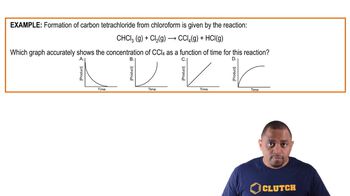
Chemical Kinetics Example
7538
views
376
rank
1
comments
Terms in this set (27)
Hide definitions
What is chemical kinetics?
The study of
rates
of chemical reactions, the factors that affect reaction rates, and the reaction mechanisms by which reactions occur.
What are reaction rates?
How fast reactants are used to form products, relative to a unit of
time
.
What is a reaction mechanism?
The
sequence of steps
that the molecule goes through to arrive at the final product.
How is reaction rate mathematically expressed for a generic reaction \(aA + bB \to cC + dD\)?
Rate = -1/a Δ[A]/Δt = -1/b Δ[B]/Δt = 1/c Δ[C]/Δt = 1/d Δ[D]/Δt; rate is relative to mol reaction, so coefficients are included.
What does the rate constant (k) represent in the rate law?
k is the
rate constant
for the reaction at one temperature, giving information on the reaction speed independent of concentration.
How is the rate law for a reaction with one reactant A expressed?
Rate ∝ [A]; Rate = k[A], where k is the rate constant.
Can reaction orders be determined from the balanced chemical equation?
No, the exponents (orders) in the rate law must be
experimentally determined
.
What does the order of a reaction indicate?
The order for each reactant is the
exponent
for that reactant in the rate law; the overall order is the sum of all exponents.
How does doubling the concentration affect the rate for zero, first, and second order reactions?
Zero order: no change; First order: rate doubles; Second order: rate quadruples (x4).
What factors affect reaction rates?
Nature of reactants, concentration of reactants, temperature, and presence of a catalyst.
What is the effect of increasing surface area on reaction rate?
More surface area exposes more molecules to reactants, increasing the reaction rate.
How is the rate law for a reaction with two reactants A and B expressed?
Rate = k[A]^x[B]^y, where x and y are the orders with respect to A and B, determined experimentally.
What is the method of initial rates used for?
To determine the reaction orders and rate constant by measuring initial rates at different initial concentrations.
What is the integrated rate law for a first order reaction?
ln([A]_0/[A]) = akt, where [A]_0 is initial concentration, [A] is concentration at time t, a is stoichiometric coefficient, and k is rate constant.
What is the half-life expression for a first order reaction?
t_1/2 = (ln 2) / (a k), independent of initial concentration.
What is the integrated rate law for a second order reaction?
1/[A] - 1/[A]_0 = a k t.
How does the half-life of a second order reaction depend on initial concentration?
t_1/2 = 1 / (a k [A]_0); half-life depends inversely on initial concentration.
What is the integrated rate law for a zeroth order reaction?
[A] = [A]_0 - a k t.
How does the half-life of a zeroth order reaction depend on initial concentration?
t_1/2 = [A]_0 / (2 a k); half-life depends directly on initial concentration.
How can reaction order be determined graphically?
First order: ln[A] vs. time is linear; Second order: 1/[A] vs. time is linear; Zeroth order: [A] vs. time is linear.
What is collision theory?
Molecules must collide with sufficient energy and proper orientation for a reaction to occur.
What is the transition state in a reaction?
A high energy intermediate formed between reactants and products; energy required to reach it is the activation energy.
What is the Arrhenius equation?
k = A e^{-Ea/(RT)}, relating rate constant k to activation energy Ea, temperature T, and frequency factor A.
How does temperature affect reaction rate according to Arrhenius equation?
Increasing temperature increases k and reaction rate, often doubling rate for every 10°C increase near room temperature.
What is the rate-determining step in a reaction mechanism?
The slowest step with the highest activation energy that controls the overall reaction rate.
What is the difference between homogeneous and heterogeneous catalysts?
Homogeneous catalysts are in the same phase as reactants; heterogeneous catalysts are in a different phase, usually solid.
What role do enzymes play in biochemical reactions?
Enzymes are biological catalysts that are highly specific and efficient, often catalyzing reactions under mild conditions.
 BackBack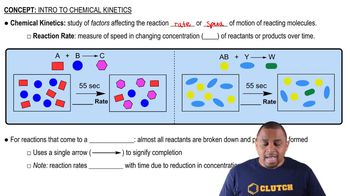
 03:06
03:06