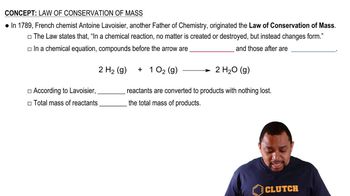
Matter is neither created nor destroyed in a chemical reaction.
Law of Definite Proportions
All samples of a given compound have the same proportions of their constituent elements.
Law of Multiple Proportions
When two elements form different compounds, the masses of one element that combine with a fixed mass of the other are in ratios of small whole numbers.
Dalton's Atomic Theory - False Statement
An atom can be broken down into smaller particles that retain the unique properties of that element is false.
Thomson's Discovery about Electrons
Electrons carry a negative charge and are about 2000 times lighter than hydrogen atoms.
Millikan's Experiment
Oil droplets were sprayed into fine droplets and their charge was measured to determine the charge of a single electron.
Modern Atomic Model of an Atom
An atom has protons and neutrons in the nucleus and electrons in orbitals surrounding the nucleus.
Largest Subatomic Particle
The neutron is the largest subatomic particle.
Smallest Subatomic Particle
The electron is the smallest subatomic particle.
Mass Number
The sum of the number of protons and neutrons in an atom.
Atomic Number
The number of protons in an atom.
Isotopes
Atoms of the same element that differ in the number of neutrons.
Ions vs Isotopes
Ions differ by the number of electrons; isotopes differ by the number of neutrons.
Charge of Protons, Neutrons, and Electrons
Protons have +1 charge, neutrons have 0 charge, electrons have -1 charge.
Cation
An atom that has lost one or more electrons and has a positive charge.
Anion
An atom that has gained one or more electrons and has a negative charge.
Atomic Mass Determination
The atomic mass is the weighted average mass of the isotopes of an element.
Mass Spectrometer
An instrument used to measure the mass of atoms and the percent abundance of isotopes.
Avogadro's Number
6.022 × 10\(^{23}\), the number of particles in one mole.
Predicting Ion Charges for Aluminum and Phosphorus
Aluminum typically forms a 3+ ion; phosphorus typically forms a 3- ion.
Properties of Metals
Good conductors of heat and electricity, tend to lose electrons, and are found on the left side of the periodic table.
Properties of Nonmetals
Poor conductors of heat and electricity, tend to gain electrons, and are found on the right side of the periodic table.
Metalloids
Elements with properties intermediate between metals and nonmetals; semiconductors.
Noble Gases
Group of elements that are very unreactive due to their full valence electron shells.
Halogens
Group 17 elements such as F, Cl, Br, and I that are reactive nonmetals.
Determining Number of Protons, Neutrons, and Electrons
Protons = atomic number; Neutrons = mass number − atomic number; Electrons = protons ± charge.
Isotopes Have Same Atomic Size Because
They have the same number of electrons; size is determined by electrons, not neutrons.
Anions Compared to Atoms
Anions are larger than their corresponding atoms due to increased electron-electron repulsion.
 Back
Back
 01:20
01:20