Skip to main content
General Chemistry
My Course
Learn
Exam Prep
AI Tutor
Study Guides
Textbook Solutions
Flashcards
Explore
Try the app
My Course
Learn
Exam Prep
AI Tutor
Study Guides
Textbook Solutions
Flashcards
Explore
Try the app
Back
General Chemistry Key Concepts and Calculations
You can tap to flip the card.
Which cation forms a precipitate with a compound that releases CO2 upon acid addition?
You can tap to flip the card.
👆
Which cation forms a precipitate with a compound that releases CO2 upon acid addition?
Cr3+
forms a precipitate in this scenario.
Track progress
Control buttons has been changed to "navigation" mode.
1/33
Recommended videos
Guided course
01:46
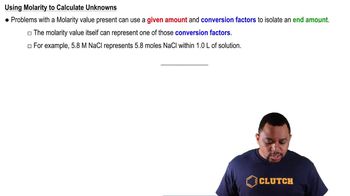
Calculate Molarity Example
11434
views
151
rank
1
comments
Guided course
01:13
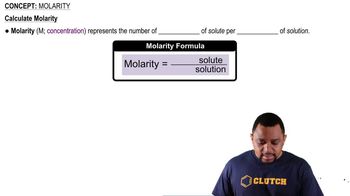
Molarity
10463
views
83
rank
1
comments
Guided course
00:53
Molarity Concept
12793
views
97
rank
1
comments
Terms in this set (33)
Hide definitions
Which cation forms a precipitate with a compound that releases CO2 upon acid addition?
Cr3+
forms a precipitate in this scenario.
In which reaction does the oxidation number of oxygen increase?
In the reaction \(2H_2O \to 2H_2 + O_2\), oxygen's oxidation number increases.
What must occur for oxidation to happen?
Reduction
must occur; oxidation cannot happen without reduction.
Which reaction will not occur as written: Mg (s) + Ca(OH)2 (aq) → Ca (s) + Mg(OH)2 (aq)?
This reaction will not occur as written.
Correct expression for molarity?
mmol solute/mL solution
is a correct expression for molarity.
Which solution has the same moles of KCl as 75.00 mL of 0.250 M KCl?
129.3 mL of 0.145 M KCl has the same moles.
Mass of KOH in 28.7 mL sample neutralized by 31.3 mL of 0.118 M HCl?
Mass of KOH is
0.207 g
.
Which requires the largest volume of 0.100 M NaOH for neutralization?
10.0 mL of 0.0500 M phosphoric acid requires the largest volume.
Spectator ions in KOH (aq) + HNO3 (aq) reaction?
K+
and
NO3-
are spectator ions.
Which are weak electrolytes among HNO3, HF, NH3, LiBr?
HF
and
NH3
are weak electrolytes.
Which hydroxides are strong bases?
Sr(OH)2, KOH, NaOH, and Ba(OH)2
are strong bases.
Which metals dissolve in aqueous nickel ion solution?
Aluminum, chromium, barium, potassium
dissolve; tin does not.
Concentration of NaCl solution from 9.3 g in 350 mL?
Concentration is
0.45 M
.
Molarity of glucose solution with 129 g in 200 mL?
Molarity is
3.58 M
.
Grams of NaCl in 55.0 mL of 1.90 M solution?
There are
6.11 g
of NaCl.
Concentration of iodide ions in 0.193 M barium iodide solution?
Iodide ion concentration is
0.386 M
.
Are any hydroxides weak bases among KOH, Ba(OH)2, RbOH, CsOH?
None of these hydroxides are weak bases.
Which compound is soluble in water at 25 °C: AgNO3, Hg2Cl2, PbCl2, Ag2S, AgCl?
AgNO3
is soluble in water at 25 °C.
Species where nitrogen has highest oxidation number?
Nitrogen has highest oxidation number in
NaNO3
.
Moles of chloride ions in 0.500 L of 0.250 M AlCl3?
There are
0.375 moles
of chloride ions.
Molarity of acetic acid solution from 20.00 mL glacial acid diluted to 500.0 mL?
Molarity is
0.699 M
.
What increases internal energy of a system?
Adding heat to the system increases internal energy.
Condition always increasing internal energy?
System gains heat and has work done on it by surroundings.
Statement of the first law of thermodynamics?
Energy lost by the system must be gained by the surroundings.
Is the reaction 4Al + 3O2 → 2Al2O3 exothermic or endothermic?
It is
exothermic
and releases heat.
Heat absorption and ΔH sign for endothermic reaction?
Endothermic reactions absorb heat and have a
positive ΔH
.
Calculate ΔE if system absorbs 12.4 J heat and does 4.2 J work on surroundings.
ΔE = 8.2 J.
Heat released forming 155 g HBr with ΔH° = -72 kJ?
Heat released is approximately
69 kJ
.
Heat released when 29.5 g Cl2 reacts with excess H2 (ΔH° = -186 kJ)?
Heat released is
77.4 kJ
.
Specific heat (J/g-K) of substance with molar heat capacity 92.1 J/mol-K and molar mass 118 g/mol?
Specific heat is
0.781 J/g-K
.
Sign of work (w) when work is done on a system?
Work done on a system has a
positive
value.
Work done (kJ) when volume expands from 19 L to 48 L against 2.5 atm?
Work done is
-7.3 kJ
.
Heat released by reaction of 10.0 g Na2O2 with water (ΔH° = -126 kJ for 2 mol)?
Heat released is approximately
8.08 kJ
.
 BackBack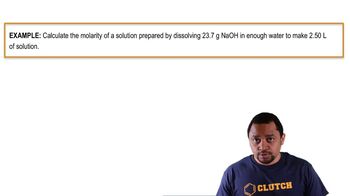
 01:46
01:46