(b) In a desert, the temperature can be as high as 45 °C, what is the temperature in °F?
Ch.1 - Introduction: Matter, Energy, and Measurement
Brown14th EditionChemistry: The Central ScienceISBN: 9780134414232Not the one you use?Change textbook
Chapter 1, Problem 35b
(b) Carbon dioxide (CO2) is a gas at room temperature and pressure. However, carbon dioxide can be put under pressure to become a 'supercritical fluid' that is a much safer dry-cleaning agent than tetrachloroethylene. At a certain pressure, the density of supercritical CO2 is 0.469 g/cm3. What is the mass of a 25.0-mL sample of supercritical CO2 at this pressure?
Verified step by step guidance1
Identify the given values: density of supercritical CO_2 is 0.469 g/cm^3 and the volume of the sample is 25.0 mL.
Recall the formula for mass using density and volume: \( \text{mass} = \text{density} \times \text{volume} \).
Substitute the given values into the formula: \( \text{mass} = 0.469 \, \text{g/cm}^3 \times 25.0 \, \text{mL} \).
Note that 1 mL is equivalent to 1 cm^3, so the units are consistent and will cancel appropriately.
Perform the multiplication to find the mass of the supercritical CO_2 sample.

Verified video answer for a similar problem:
This video solution was recommended by our tutors as helpful for the problem above.
Video duration:
3mWas this helpful?
Key Concepts
Here are the essential concepts you must grasp in order to answer the question correctly.
Density
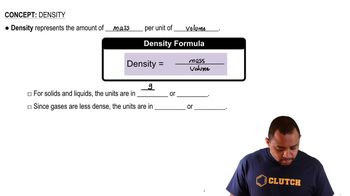
Density is defined as mass per unit volume, typically expressed in grams per cubic centimeter (g/cm³). It is a crucial property that helps determine how much mass is contained in a given volume of a substance. In this question, the density of supercritical CO₂ is provided, allowing us to calculate the mass of a specific volume of the substance.
Recommended video:
Guided course
Density Concepts
Supercritical Fluids
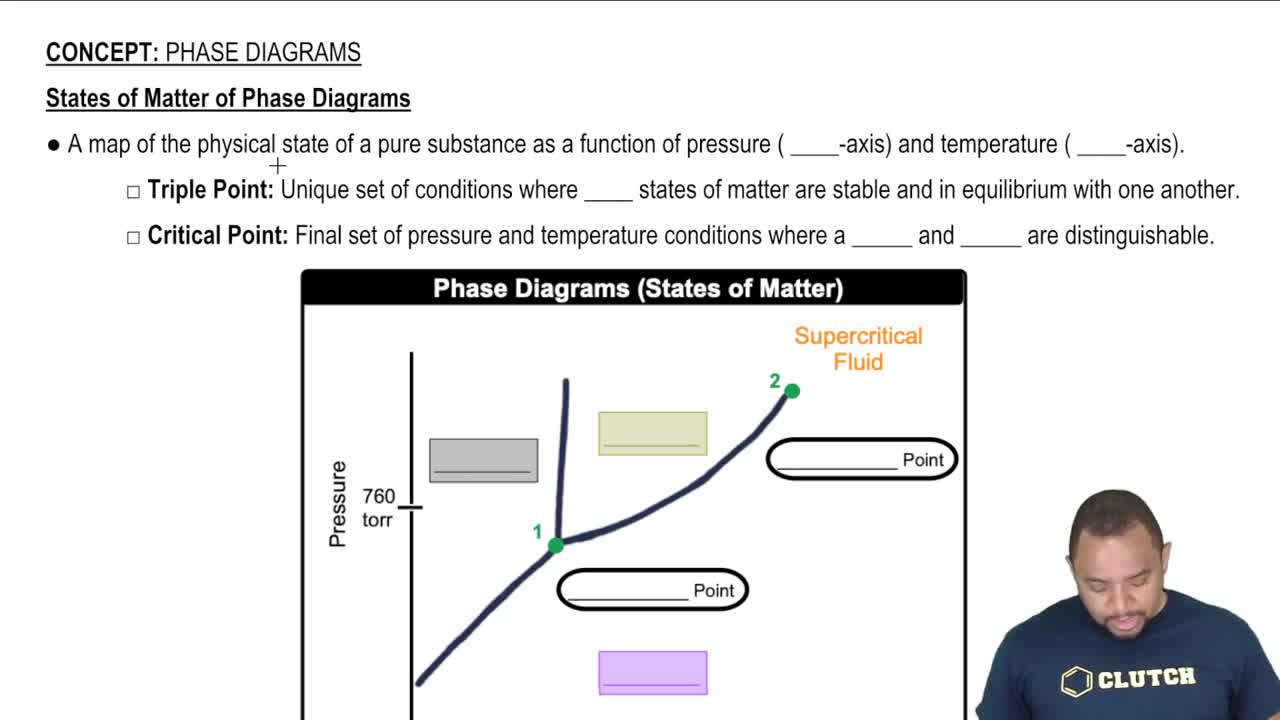
Supercritical fluids occur when a substance is subjected to temperature and pressure above its critical point, resulting in unique properties that are distinct from gases and liquids. Supercritical CO₂, for example, can dissolve materials like a liquid while maintaining the diffusivity of a gas, making it useful in applications such as dry cleaning. Understanding this concept is essential for grasping the context of the question.
Recommended video:
Guided course
States of Matter of Phase Diagrams
Mass Calculation
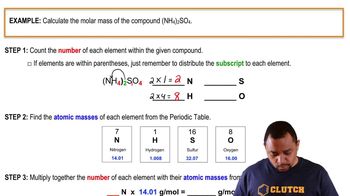
Mass calculation involves using the formula mass = density × volume. In this scenario, knowing the density of supercritical CO₂ and the volume of the sample allows us to compute the mass. This fundamental relationship is key to solving the problem presented in the question.
Recommended video:
Guided course
Molar Mass Calculation Example
Related Practice
Textbook Question
697
views
Textbook Question
(c) Is a graduated cylinder such as that shown in Figure 1.21 likely to afford the accuracy of measurement needed?
635
views
Textbook Question
(a) A child has a fever of 101 °F. What is the temperature in °C?
1560
views
Textbook Question
(a) A sample of tetrachloroethylene, a liquid used in dry cleaning that is being phased out because of its potential to cause cancer, has a mass of 40.55 g and a volume of 25.0 mL at 25 °C. What is its density at this temperature? Will tetrachloroethylene float on water? (Materials that are less dense than water will float.)
1302
views
Textbook Question
(b) An experiment requires 45.0 g of ethylene glycol, a liquid whose density is 1.114 g/mL. Rather than weigh the sample on a balance, a chemist chooses to dispense the liquid using a graduated cylinder. What volume of the liquid should he use?
1037
views