For each of the following processes, does the potential energy of the object(s) increase or decrease? (b) Water is pumped from ground level to the reservoir of a water tower 30 m above the ground.
Ch.1 - Introduction: Matter, Energy, and Measurement
Brown14th EditionChemistry: The Central ScienceISBN: 9780134414232Not the one you use?Change textbook
Chapter 1, Problem 25
Convert this energy to calories. When the bullet is stopped by a bulletproof vest, which form of energy does the kinetic energy of the bullet convert to?
Verified step by step guidance1
Identify the initial form of energy: The bullet initially possesses kinetic energy due to its motion.
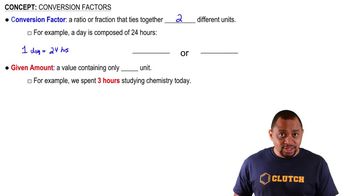
Determine the conversion factor: To convert energy from joules to calories, use the conversion factor 1 calorie = 4.184 joules.
Set up the conversion equation: If the energy in joules is given as E, the energy in calories can be calculated using the equation: .
Consider the energy transformation: When the bullet is stopped by the vest, its kinetic energy is converted primarily into thermal energy due to friction and deformation.
Understand the implications: The conversion of kinetic energy to thermal energy results in an increase in temperature of the vest and the bullet, demonstrating the principle of energy conservation.
Key Concepts
Here are the essential concepts you must grasp in order to answer the question correctly.
Kinetic Energy
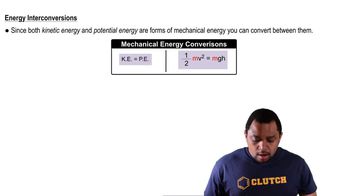
Kinetic energy is the energy possessed by an object due to its motion. It is calculated using the formula KE = 1/2 mv², where m is the mass and v is the velocity of the object. In the context of the bullet, its kinetic energy is what allows it to penetrate materials until it is stopped by a bulletproof vest.
Recommended video:
Guided course
Kinetic & Potential Energy
Energy Conversion
Energy conversion refers to the process of changing energy from one form to another. When the bullet strikes the vest, its kinetic energy is converted into other forms of energy, primarily thermal energy (heat) and sound energy, as the vest absorbs the impact and dissipates the energy.
Recommended video:
Guided course
Conversion Factors
Caloric Energy
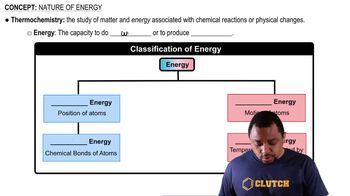
Caloric energy is a measure of energy defined in terms of calories, where one calorie is the amount of energy needed to raise the temperature of one gram of water by one degree Celsius. In the context of the question, converting energy to calories involves understanding how to quantify the energy lost by the bullet in terms of heat produced when it is stopped.
Recommended video:
Guided course
Nature of Energy
Related Practice
Textbook Question
455
views
Textbook Question
Two positively charged particles are first brought close together and then released. Once released, the repulsion between particles causes them to move away from each other. (b) Does the potential energy of the two particles prior to release increase or decrease as the distance between them is increased.
1015
views
1
rank
Textbook Question
(a) Calculate the kinetic energy, in joules, of a 15-g bullet moving at 120 m/s.
696
views
Textbook Question
A silvery metal is put inside a beaker of water. Bubbles form on the surface of the metal and it dissolves gradually. (a) Is this an example of a chemical or a physical change?
692
views