Classify each of the following as a pure substance or a mixture. If a mixture, indicate whether it is homogeneous or heterogeneous: (c) aluminium
Ch.1 - Introduction: Matter, Energy, and Measurement
Brown14th EditionChemistry: The Central ScienceISBN: 9780134414232Not the one you use?Change textbook
Chapter 1, Problem 13a,b
Classify each of the following as a pure substance or a mixture. If a mixture, indicate whether it is homogeneous or heterogeneous: (a) air (b) chocolate with almond
Verified step by step guidance1
Step 1: Understand the definitions. A pure substance consists of a single type of element or compound, with a uniform and definite composition. A mixture contains two or more substances that are not chemically combined and can be either homogeneous or heterogeneous.
Step 2: Analyze 'air'. Air is composed of various gases such as nitrogen, oxygen, carbon dioxide, and others. Since these gases are mixed together without chemical bonding, air is a mixture.
Step 3: Determine the type of mixture for 'air'. The composition of air is uniform throughout, meaning it is the same in every sample. Therefore, air is a homogeneous mixture.
Step 4: Analyze 'chocolate with almond'. This consists of chocolate and almond pieces mixed together. Since these components are not chemically bonded and can be physically separated, it is a mixture.
Step 5: Determine the type of mixture for 'chocolate with almond'. The composition is not uniform, as you can see and separate the almond pieces from the chocolate. Therefore, chocolate with almond is a heterogeneous mixture.
Key Concepts
Here are the essential concepts you must grasp in order to answer the question correctly.
Pure Substances
A pure substance consists of a single type of particle and has a uniform and definite composition. Examples include elements like oxygen and compounds like water. Pure substances have consistent properties throughout, such as boiling and melting points, which distinguish them from mixtures.
Recommended video:
Guided course
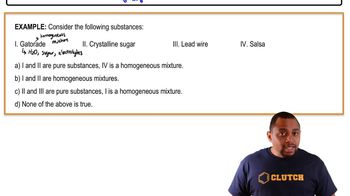
Classification of Matter Example
Mixtures
Mixtures are combinations of two or more substances that retain their individual properties. They can be classified as homogeneous, where the composition is uniform throughout (like saltwater), or heterogeneous, where the composition varies (like a salad). The components in a mixture can often be separated by physical means.
Homogeneous vs. Heterogeneous Mixtures
Homogeneous mixtures have a uniform composition and appearance, meaning that the different components are not distinguishable. In contrast, heterogeneous mixtures contain visibly different substances or phases, allowing for the identification of individual components. Understanding this distinction is crucial for classifying mixtures correctly.
Related Practice
Textbook Question
807
views
Textbook Question
Consider the jar of jelly beans in the photo. To get an estimateof the number of beans in the jar you weigh six beansand obtain masses of 3.15, 3.12, 2.98, 3.14, 3.02, and 3.09 g.Then you weigh the jar with all the beans in it, and obtain amass of 2082 g. The empty jar has a mass of 653 g. Based onthese data, estimate the number of beans in the jar. Justifythe number of significant figures you use in your estimate.
885
views
Textbook Question
(a) What is the length of the pencil in the following figure if the ruler reads in centimeters? How many significant figures are there in this measurement?
918
views
Textbook Question
Classify each of the following as a pure substance or a mixture. If a mixture, indicate whether it is homogeneous or heterogeneous: (d) iodine tincture.
792
views
Textbook Question
Classify each of the following as a pure substance or a mixture. If a mixture, indicate whether it is homogeneous or heterogeneous: (a) milk
1246
views
Textbook Question
(b) An automobile speedometer with circular scales reading both miles per hour and kilometers per hour is shown. What speed is indicated, in both units? How many significant figures are in the measurements?
568
views