(a) Three spheres of equal size are composed of aluminum (density = 2.70 g/cm3), silver (density = 10.49 g/cm3), and nickel (density = 8.90 g/cm3). List the spheres from lightest to heaviest.
Ch.1 - Introduction: Matter, Energy, and Measurement
Brown14th EditionChemistry: The Central ScienceISBN: 9780134414232Not the one you use?Change textbook
Chapter 1, Problem 5
Is the separation method used in brewing a cup of coffee best described as distillation, filtration, or chromatography?
Verified step by step guidance1
Understand the process of brewing coffee: Hot water is passed through ground coffee beans, extracting flavors and compounds to produce a liquid coffee solution.
Identify the components involved: The coffee grounds are the solid phase, and the water is the liquid phase that extracts soluble compounds.
Consider the separation methods: Distillation involves separating components based on boiling points, filtration involves separating solids from liquids, and chromatography involves separating components based on their movement through a medium.
Determine which method applies: In brewing coffee, the goal is to separate the liquid coffee from the solid coffee grounds.
Conclude that filtration is the best description: The process of brewing coffee primarily involves filtering the liquid coffee from the solid grounds, making filtration the most appropriate separation method.
Key Concepts
Here are the essential concepts you must grasp in order to answer the question correctly.
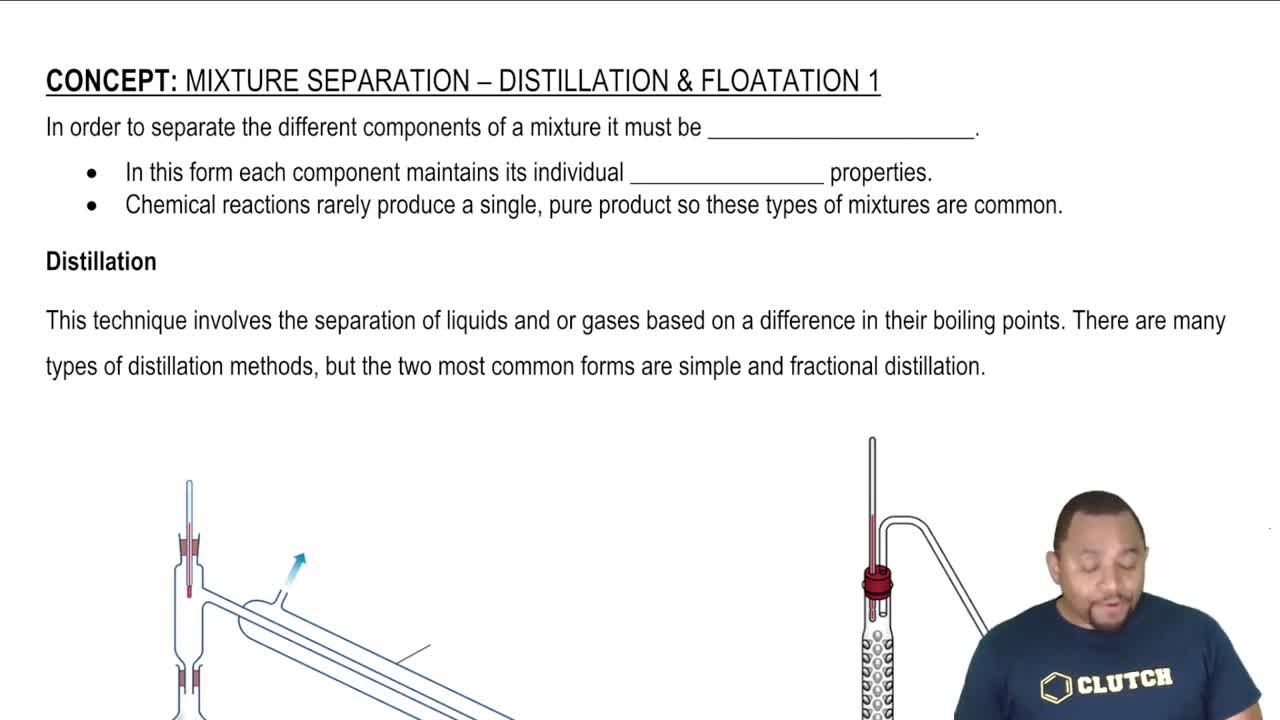
Distillation
Distillation is a separation technique that relies on differences in boiling points to separate components of a mixture. It involves heating a liquid to create vapor and then cooling the vapor to form a liquid again. This method is commonly used for purifying liquids or separating liquid mixtures, but it is not typically used in brewing coffee.
Recommended video:
Guided course
Distillation and Floatation
Filtration
Filtration is a physical separation process that uses a porous barrier to separate solids from liquids or gases. In coffee brewing, filtration is employed to remove coffee grounds from the brewed liquid, allowing only the liquid coffee to pass through. This method is essential for producing a clean cup of coffee without sediment.
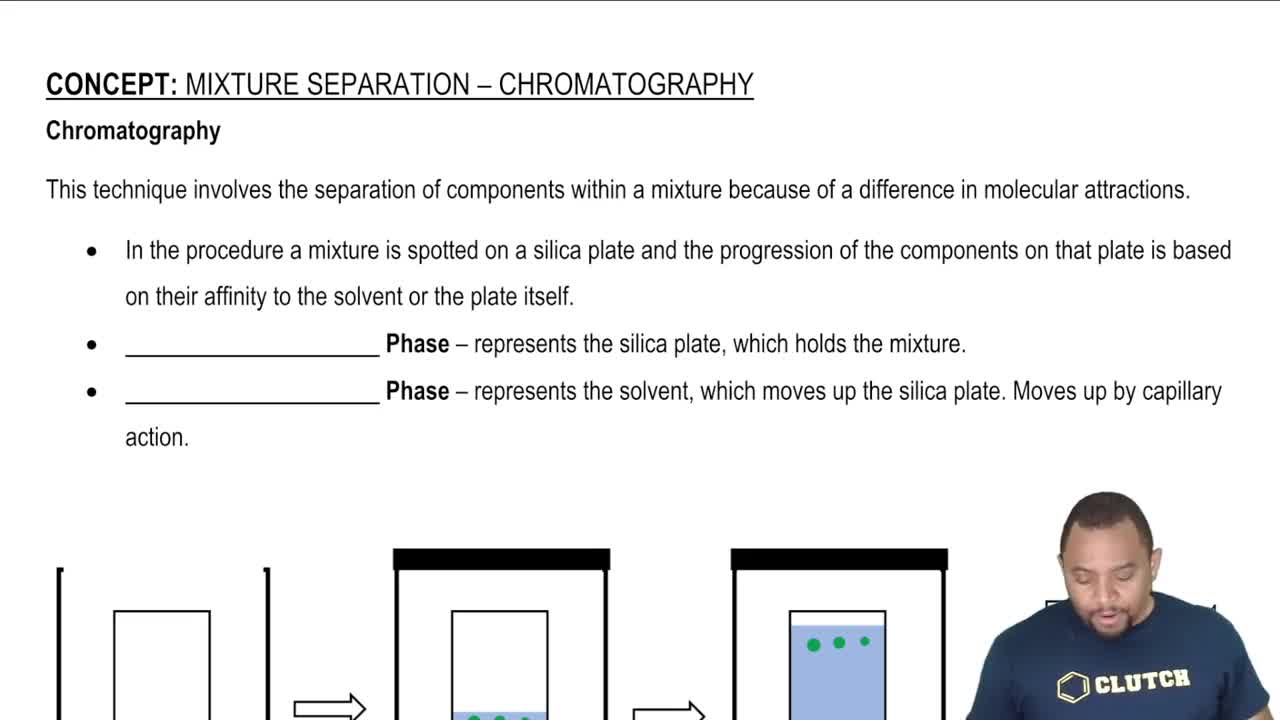
Chromatography
Chromatography is a technique used to separate components of a mixture based on their movement through a stationary phase under the influence of a mobile phase. While it is a powerful analytical tool in chemistry for separating complex mixtures, it is not a method used in the brewing process of coffee, which primarily relies on extraction and filtration.
Recommended video:
Guided course
Chromatography
Related Practice
Textbook Question
834
views
Textbook Question
Identify each of the following as measurements of length, area, volume, mass, density, time, or temperature: (a) 25 ps, (b) 374.2 mg, (c) 77 K, (d) 100,000 km2, (e) 1.06 mm, (f) 16 nm2, (g) -78 °C, (h) 2.56 g>cm3, (i) 28 cm3.
1259
views
2
rank
4
comments
Textbook Question
(b) Three cubes of equal mass are composed of gold (density = 19.32 g/cm3), platinum (density = 21.45 g/cm3), and lead (density = 11.35 g/cm3). List the cubes from smallest to largest.
1059
views
Textbook Question
Consider the two spheres shown here, one made of silver and the other of aluminum. (d) If you release the spheres simultaneously, they will have the same velocity when they hit the ground. Will they have the same kinetic energy? If not, which sphere will have more kinetic energy?
400
views
Textbook Question
Consider the two spheres shown here, one made of silver and the other of aluminum. (a) What is the mass of each sphere in kg?
450
views
Textbook Question
Consider the two spheres shown here, one made of silver and the other of aluminum. (a) What is the mass of each sphere in kg?
347
views