Using your knowledge of metric units, English units, and the information on the back inside cover, write down the conversion factors needed to convert (c) mi to km
Ch.1 - Introduction: Matter, Energy, and Measurement
Brown14th EditionChemistry: The Central ScienceISBN: 9780134414232Not the one you use?Change textbook
Chapter 1, Problem 53d
Using your knowledge of metric units, English units, and the information on the back inside cover, write down the conversion factors needed to convert (d) in.3 to cm3.
Verified step by step guidance1
Identify the conversion factor between inches and centimeters: 1 inch = 2.54 cm.
Recognize that you are converting volume, so you need to cube the linear conversion factor: (1 in)^3 = (2.54 cm)^3.
Calculate the conversion factor for cubic inches to cubic centimeters: 1 in^3 = (2.54 cm)^3.
Express the conversion factor as a single equation: 1 in^3 = 2.54^3 cm^3.
Use this conversion factor to convert any given volume in cubic inches to cubic centimeters by multiplying the volume in in^3 by 2.54^3.
Key Concepts
Here are the essential concepts you must grasp in order to answer the question correctly.
Metric and English Units
Metric units, such as centimeters and cubic centimeters, are part of the International System of Units (SI), which is based on powers of ten. English units, like inches and cubic inches, are part of a different measurement system commonly used in the United States. Understanding the differences between these systems is crucial for accurate conversions.
Recommended video:
Guided course
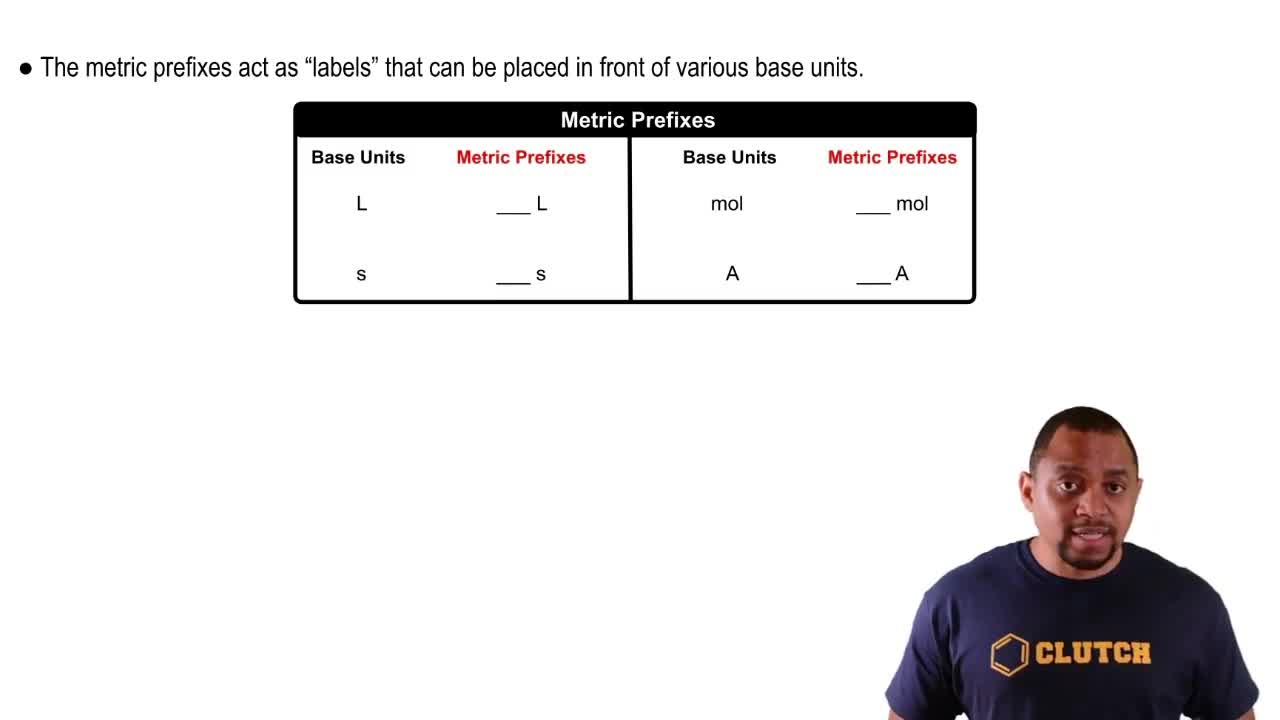
Metric Prefixes Usage
Volume Conversion
Volume is a measure of the space occupied by a substance, typically expressed in cubic units. To convert between different volume units, one must know the relationship between the units involved. For example, 1 inch is equal to 2.54 centimeters, and thus, to convert cubic inches to cubic centimeters, one must cube the conversion factor for linear dimensions.
Conversion Factors
A conversion factor is a numerical factor used to multiply or divide a quantity when converting from one unit to another. It is derived from the equivalence between two different units. For instance, to convert from cubic inches to cubic centimeters, the conversion factor is (2.54 cm/inch)³, which accounts for the three-dimensional nature of volume.
Recommended video:
Guided course
Conversion Factors
Related Practice
Textbook Question
455
views
Textbook Question
Using your knowledge of metric units, English units, and the information on the back inside cover, write down the conversion factors needed to convert (a) in. to cm
Textbook Question
Using your knowledge of metric units, English units, and the information on the back inside cover, write down the conversion factors needed to convert (a) km/hr to m/s
Textbook Question
(a) A bumblebee flies with a ground speed of 15.2 m/s. Calculate its speed in km/hr.
902
views
Textbook Question
You have a graduated cylinder that contains a liquid (see photograph). Write the volume of the liquid, in milliliters, using the proper number of significant figures.
989
views
3
comments
Textbook Question
Using your knowledge of metric units, English units, and the information on the back inside cover, write down the conversion factors needed to convert (c) km to ft
457
views