
Which of the following statements best explains why a closed balloon filled with helium gas rises in air? (a) Helium is a monatomic gas, whereas nearly all the molecules that make up air, such as nitrogen and oxygen, are diatomic. (b) The average speed of helium atoms is greater than the average speed of air molecules, and the greater speed of collisions with the balloon walls propels the balloon upward. (c) Because the helium atoms are of lower mass than the average air molecule, the helium gas is less dense than air. The mass of the balloon is thus less than the mass of the air displaced by its volume. (d) Because helium has a lower molar mass than the average air molecule, the helium atoms are in faster motion. This means that the temperature of the helium is greater than the air temperature. Hot gases tend to rise.
Ch.10 - Gases

Brown14th EditionChemistry: The Central ScienceISBN: 9780134414232
Not the one you use?Change textbookSelect a different textbook
Table of contents
- Ch.1 - Introduction: Matter, Energy, and Measurement140
- Ch.2 - Atoms, Molecules, and Ions192
- Ch.3 - Chemical Reactions and Reaction Stoichiometry172
- Ch.4 - Reactions in Aqueous Solution156
- Ch.5 - Thermochemistry151
- Ch.6 - Electronic Structure of Atoms137
- Ch.7 - Periodic Properties of the Elements127
- Ch.8 - Basic Concepts of Chemical Bonding143
- Ch.9 - Molecular Geometry and Bonding Theories167
- Ch.10 - Gases147
- Ch.11 - Liquids and Intermolecular Forces97
- Ch.12 - Solids and Modern Materials129
- Ch.13 - Properties of Solutions126
- Ch.14 - Chemical Kinetics175
- Ch.15 - Chemical Equilibrium107
- Ch.16 - Acid-Base Equilibria127
- Ch.17 - Additional Aspects of Aqueous Equilibria133
- Ch.18 - Chemistry of the Environment88
- Ch.19 - Chemical Thermodynamics140
- Ch.20 - Electrochemistry137
- Ch.21 - Nuclear Chemistry99
- Ch.22 - Chemistry of the Nonmetals66
- Ch.23 - Transition Metals and Coordination Chemistry69
- Ch.24 - The Chemistry of Life: Organic and Biological Chemistry11
Brown14th EditionChemistry: The Central ScienceISBN: 9780134414232Not the one you use?Change textbook
Chapter 10, Problem 54
The molar mass of a volatile substance was determined bythe Dumas-bulb method described in Exercise 10.53. Theunknown vapor had a mass of 2.55 g; the volume of thebulb was 500 mL, pressure 101.33 kPa, and temperature37 °C.Calculate the molar mass of the unknown vapor.
 Verified step by step guidance
1
Convert the temperature from Celsius to Kelvin by adding 273.15 to the Celsius temperature.
Convert the volume from milliliters to liters by dividing by 1000.
Use the ideal gas law equation, PV = nRT, to solve for the number of moles (n) of the gas. Here, P is the pressure in kPa, V is the volume in liters, R is the ideal gas constant (8.314 L·kPa/mol·K), and T is the temperature in Kelvin.
Rearrange the ideal gas law equation to solve for n: n = PV / RT.
Calculate the molar mass by dividing the mass of the vapor (2.55 g) by the number of moles (n) calculated in the previous step.
Verified video answer for a similar problem:
This video solution was recommended by our tutors as helpful for the problem above.

Video duration:
5mWas this helpful?
Key Concepts
Here are the essential concepts you must grasp in order to answer the question correctly.
Ideal Gas Law
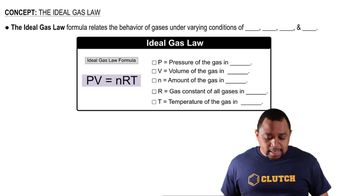
The Ideal Gas Law relates the pressure, volume, temperature, and number of moles of a gas through the equation PV = nRT. This law is essential for calculating the molar mass of gases, as it allows us to determine the number of moles (n) from the known values of pressure (P), volume (V), and temperature (T), using the ideal gas constant (R).
Recommended video:
Guided course
 01:15
01:15
Ideal Gas Law Formula
Molar Mass Calculation
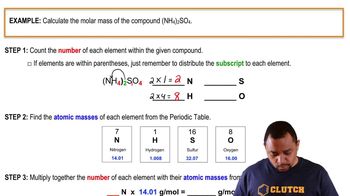
Molar mass is defined as the mass of one mole of a substance, typically expressed in grams per mole (g/mol). To calculate the molar mass of a gas using the Ideal Gas Law, we can rearrange the equation to find n (moles) and then use the formula: Molar Mass = mass (g) / n (moles). This allows us to derive the molar mass from the mass of the gas and the conditions under which it was measured.
Recommended video:
Guided course
 03:12
03:12Molar Mass Calculation Example
Dumas Method
The Dumas method is a technique used to determine the molar mass of volatile substances by measuring the mass of vapor produced in a controlled environment. In this method, the vapor is collected in a bulb, and its properties (mass, volume, pressure, and temperature) are measured to apply the Ideal Gas Law, facilitating the calculation of the substance's molar mass.
Recommended video:
Guided course
 01:49
01:49Method 1 of Radioactive Half-Life
Related Practice
Textbook Question
1663
views
Textbook Question
(a) Calculate the density of NO2 gas at 0.970 atm and 35 °C.
559
views
Textbook Question
Magnesium can be used as a 'getter' in evacuated enclosuresto react with the last traces of oxygen. (The magnesium isusually heated by passing an electric current through a wireor ribbon of the metal.) If an enclosure of 5.67 L has a partialpressure of O2 of 7.066 mPa at 30 °C, what mass of magnesiumwill react according to the following equation?2 Mg1s2 + O21g2¡2 MgO1s2
550
views
Textbook Question
(b) Calculate the molar mass of a vapor thathas a density of 7.135 g>L at 12 °C and 99.06 kPa.
1066
views
Textbook Question
During a person's typical breathing cycle, the CO2 concentration in the expired air rises to a peak of 4.6% by volume.(a) Calculate the partial pressure of the CO2 in the expiredair at its peak, assuming 1 atm pressure and a body temperature of 37 °C.
1363
views