(b) Carbon dioxide makes up approximately 0.04% of Earth's atmosphere. If you collect a 2.0-L sample from the atmosphere at sea level (101.33 kPa) on a warm day 127 °C2, how many CO2 molecules are in your sample?
Ch.10 - Gases
Brown14th EditionChemistry: The Central ScienceISBN: 9780134414232Not the one you use?Change textbook
Chapter 10, Problem 40a
An aerosol spray can with a volume of 125 mL contains 1.30 g of propane gas (C3H8) as a propellant. (a) If the can is at 25 °C, what is the pressure in the can?
Verified step by step guidance1

Verified video answer for a similar problem:
This video solution was recommended by our tutors as helpful for the problem above.
Video duration:
5mWas this helpful?
Key Concepts
Here are the essential concepts you must grasp in order to answer the question correctly.
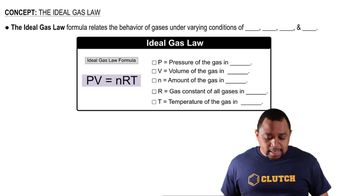
Ideal Gas Law
The Ideal Gas Law is a fundamental equation in chemistry that relates the pressure, volume, temperature, and number of moles of a gas. It is expressed as PV = nRT, where P is pressure, V is volume, n is the number of moles, R is the ideal gas constant, and T is temperature in Kelvin. This law allows us to calculate the pressure of a gas when its volume, temperature, and amount are known.
Recommended video:
Guided course
Ideal Gas Law Formula
Molar Mass
Molar mass is the mass of one mole of a substance, typically expressed in grams per mole (g/mol). For propane (C3H8), the molar mass can be calculated by summing the atomic masses of its constituent elements: carbon (C) and hydrogen (H). Knowing the molar mass is essential for converting grams of a substance to moles, which is necessary for applying the Ideal Gas Law.
Recommended video:
Guided course
Molar Mass Concept
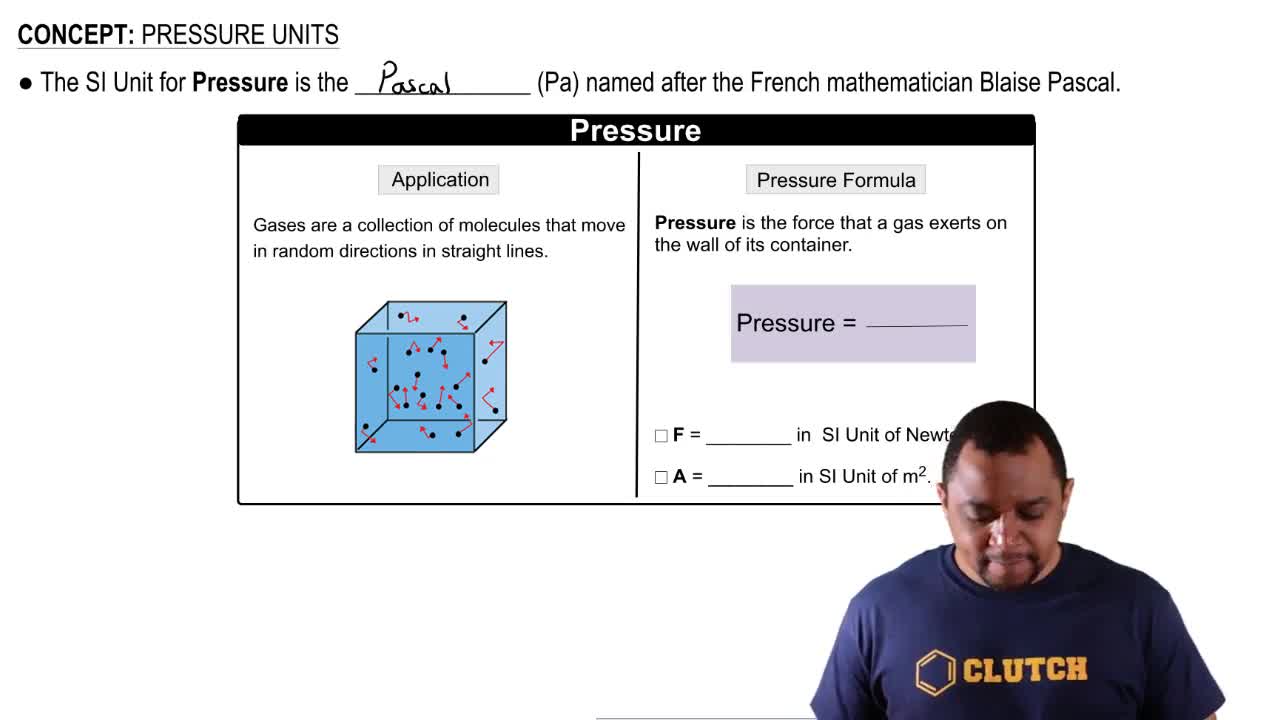
Gas Pressure
Gas pressure is the force exerted by gas molecules colliding with the walls of their container. It is typically measured in units such as atmospheres (atm) or pascals (Pa). In the context of the aerosol can, understanding how temperature and the number of gas molecules affect pressure is crucial for determining the pressure inside the can using the Ideal Gas Law.
Recommended video:
Guided course
Pressure Units
Related Practice
Textbook Question
1632
views
Textbook Question
Chlorine is widely used to purify municipal water supplies and to treat swimming pool waters. Suppose that the volume of a particular sample of Cl2 gas is 8.70 L at 119.3 kPa and 24 °C. (b) What volume will the Cl2 occupy at STP?
1087
views
Textbook Question
(a) If the pressure exerted by ozone, O3, in the stratosphere is 304 Pa and the temperature is 250 K, how many ozone molecules are in a liter?
988
views
Textbook Question
A scuba diver's tank contains 2.50 kg of O2 compressed intoa volume of 11.0 L. (b) What volume would this oxygen occupy at25 °C and 101.33 kPa?
650
views
Textbook Question
A 50.0 g sample of solid CO2 (dry ice) is added at -100 °C toan evacuated (all of the gas removed) container with a volumeof 5.0 L. If the container is sealed and then allowed to warmto room temperature 125 °C2 so that the entire solid CO2 isconverted to a gas, what is the pressure inside the container?
1396
views
Textbook Question
Chlorine is widely used to purify municipal water supplies and to treat swimming pool waters. Suppose that the volume of a particular sample of Cl2 gas is 8.70 L at 119.3 kPa and 24 °C. (c) At what temperature will the volume be 15.00 L if the pressure is 116.8 kPa
938
views