
A sample of 3.00 g of SO2(g) originally in a 5.00-L vessel at 21 °C is transferred to a 10.0-L vessel at 26 °C. A sample of 2.35 g of N2(g) originally in a 2.50-L vessel at 20 °C is transferred to this same 10.0-L vessel. (c) What is the total pressure in the vessel?
Ch.10 - Gases
Brown14th EditionChemistry: The Central ScienceISBN: 9780134414232Not the one you use?Change textbook
Chapter 10, Problem 72b
(b) What is the partial pressure in atm of each component of this mixture if its held in a 15.50-L vessel at 15 °C?
Verified step by step guidance1
Step 1: Begin by identifying the components of the gas mixture. You will need the number of moles of each gas present in the mixture.
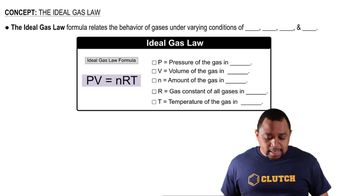
Step 2: Use the Ideal Gas Law, which is expressed as , where is the pressure, is the volume, is the number of moles, is the ideal gas constant, and is the temperature in Kelvin.
Step 3: Convert the temperature from Celsius to Kelvin using the formula . For 15 °C, calculate the temperature in Kelvin.
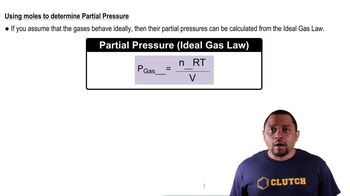
Step 4: Calculate the partial pressure of each gas using the Ideal Gas Law. Rearrange the formula to solve for pressure: . Substitute the values for each gas component.
Step 5: Ensure that the units are consistent, particularly for the ideal gas constant , which is typically L atm/mol K. Calculate the partial pressure for each component in atm.

Verified video answer for a similar problem:
This video solution was recommended by our tutors as helpful for the problem above.
Video duration:
6mWas this helpful?
Key Concepts
Here are the essential concepts you must grasp in order to answer the question correctly.
Partial Pressure
Partial pressure is the pressure exerted by a single component of a gas mixture. According to Dalton's Law of Partial Pressures, the total pressure of a gas mixture is equal to the sum of the partial pressures of its individual components. This concept is crucial for calculating the contribution of each gas in a mixture to the overall pressure in a confined space.
Recommended video:
Guided course
Partial Pressure Calculation
Ideal Gas Law
The Ideal Gas Law relates the pressure, volume, temperature, and number of moles of a gas through the equation PV = nRT. This law is essential for determining the behavior of gases under various conditions. In this context, it can be used to calculate the partial pressures of each gas in the mixture when the total volume and temperature are known.
Recommended video:
Guided course
Ideal Gas Law Formula
Gas Mixtures
Gas mixtures consist of two or more gases that occupy the same volume and exert pressure independently. The behavior of each gas in a mixture can be analyzed separately, allowing for the application of the Ideal Gas Law to each component. Understanding how to treat gas mixtures is vital for accurately calculating the partial pressures of each gas in a given volume and temperature.
Related Practice
Textbook Question
Textbook Question
(a) What are the mole fractions of H2 in a mixture of 15.08 g of O2, 8.17 g of N2, and 2.64 g of H2?
774
views
Textbook Question
A sample of 3.00 g of SO2(g) originally in a 5.00-L vessel at 21 °C is transferred to a 10.0-L vessel at 26 °C. A sample of 2.35 g of N2(g) originally in a 2.50-L vessel at 20 °C is transferred to this same 10.0-L vessel. (a) What is the partial pressure of SO2(g) in the larger container? (b) What is the partial pressure of N2(g) in this vessel?
491
views
Textbook Question
(a) What are the mole fractions of N2 in a mixture of 15.08 g of O2, 8.17 g of N2, and 2.64 g of H2?
884
views
Textbook Question
At an underwater depth of 100 m, the pressure is 1.106 MPa.What should the partial pressure of oxygen be in the divinggas for the mole fraction of oxygen in the mixture to be 0.21,the same as in air?
1268
views
Textbook Question
A quantity of N2 gas originally held at 531.96 kPa pressurein a 1.00-L container at 26 °C is transferred to a 12.5-L containerat 20 °C. A quantity of O2 gas originally at 531.96 kPaand 26 °C in a 5.00-L container is transferred to this samecontainer. What is the total pressure in the new container?
802
views
