
A person weighing 75 kg is standing on a threelegged stool. The stool momentarily tilts so that the entire weight is on one foot. If the contact area of each foot is 5.0 cm2, calculate the pressure exerted on the underlying surface in (b) atmospheres
(c) Which is most likely to be a gas at room temperature and ordinary atmospheric pressure, F2, Br2, K2O?
Verified step by step guidance
Verified video answer for a similar problem:
Key Concepts
States of Matter
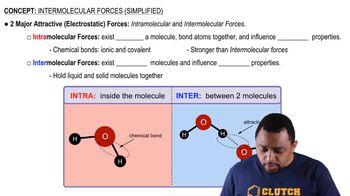
Molecular Weight and Intermolecular Forces
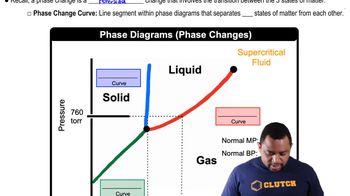
Phase Diagrams
A person weighing 75 kg is standing on a threelegged stool. The stool momentarily tilts so that the entire weight is on one foot. If the contact area of each foot is 5.0 cm2, calculate the pressure exerted on the underlying surface in (a) bars
The graph below shows the change in pressure as the temperature increases for a 1-mol sample of a gas confined to a 1-L container. The four plots correspond to an ideal gas and three real gases: CO2, N2, and Cl2. (b) Use the van der Waals constants in Table 10.3 to match the labels in the plot (A, B, and C) with the respective gases 1CO2, N2, and Cl22.
A person weighing 75 kg is standing on a threelegged stool. The stool momentarily tilts so that the entire weight is on one foot. If the contact area of each foot is 5.0 cm2, calculate the pressure exerted on the underlying surface in (c) pounds per square inch
(b) Which units are appropriate for expressing atmospheric pressures, N, Pa, atm, kg/m2?
