
Both Jacques Charles and Joseph Louis Guy-Lussac were avid balloonists. In his original flight in 1783, Jacques Charles used a balloon that contained approximately 31,150 L of H2. He generated the H2 using the reaction between iron and hydrochloric acid: Fe1s2 + 2 HCl1aq2 ¡ FeCl21aq2 + H21g2 How many kilograms of iron were needed to produce this volume of H2 if the temperature was 22 °C?
Ch.10 - Gases
Brown14th EditionChemistry: The Central ScienceISBN: 9780134414232Not the one you use?Change textbook
Chapter 10, Problem 61a2
Consider the apparatus shown in the following drawing. (a) When the valve between the two containers is opened and the gases are allowed to mix, what is the partial pressure of N2 after mixing?

Verified step by step guidance1
Step 1: Identify the initial conditions for each gas. For He: Volume (V1) = 1.5 L, Pressure (P1) = 1.0 atm, Temperature (T) = 26°C. For Ar: Volume (V2) = 2.5 L, Pressure (P2) = 1.5 atm, Temperature (T) = 26°C.
Step 2: Calculate the total volume after the valve is opened. Total Volume (V_total) = V1 + V2 = 1.5 L + 2.5 L.
Step 3: Use the ideal gas law to find the number of moles of N2 in each container before mixing. For He: n1 = (P1 * V1) / (R * T). For Ar: n2 = (P2 * V2) / (R * T).
Step 4: Calculate the total number of moles of N2 after mixing. Total moles (n_total) = n1 + n2.
Step 5: Use the ideal gas law to find the partial pressure of N2 after mixing. P_total = (n_total * R * T) / V_total.

Verified video answer for a similar problem:
This video solution was recommended by our tutors as helpful for the problem above.
Video duration:
2mWas this helpful?
Key Concepts
Here are the essential concepts you must grasp in order to answer the question correctly.
Partial Pressure
Partial pressure is the pressure exerted by a single gas in a mixture of gases. According to Dalton's Law of Partial Pressures, the total pressure of a gas mixture is the sum of the partial pressures of each individual gas. This concept is crucial for determining the behavior of gases when they are allowed to mix, as it helps in calculating the contribution of each gas to the overall pressure.
Recommended video:
Guided course
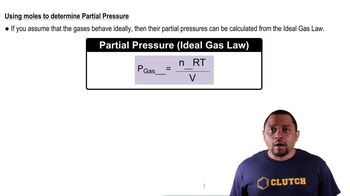
Partial Pressure Calculation
Ideal Gas Law
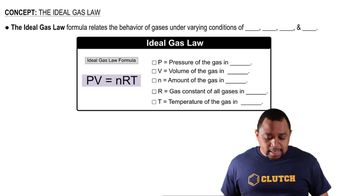
The Ideal Gas Law relates the pressure, volume, temperature, and number of moles of a gas through the equation PV = nRT. This law assumes that gases behave ideally, meaning they occupy no volume and have no intermolecular forces. Understanding this law is essential for solving problems involving gas mixtures, as it allows for the calculation of changes in pressure and volume when gases are combined.
Recommended video:
Guided course
Ideal Gas Law Formula
Gas Mixture Calculations
When dealing with gas mixtures, it is important to apply the principles of gas laws to determine the final conditions after mixing. This involves calculating the total volume and using the initial pressures and volumes of the individual gases to find their new partial pressures. These calculations are fundamental in predicting how gases will behave when they are allowed to mix in a closed system.
Recommended video:
Guided course
Gas Stoichiometry Calculation Example
Related Practice
Textbook Question
844
views
Textbook Question
During a person's typical breathing cycle, the CO2 concentration in the expired air rises to a peak of 4.6% by volume.(a) Calculate the partial pressure of the CO2 in the expiredair at its peak, assuming 1 atm pressure and a body temperature of 37 °C.
1363
views
Textbook Question
Acetylene gas, C2H21g2, can be prepared by the reaction ofcalcium carbide with water:CaC21s2 + 2 H2O1l2¡Ca1OH221aq2 + C2H21g2Calculate the volume of C2H2 that is collected over water at23 °C by reaction of 1.524 g of CaC2 if the total pressure ofthe gas is 100.4 kPa. (The vapor pressure of water is tabulatedin Appendix B.)
988
views
Textbook Question
Consider the apparatus shown in the following drawing. (a) When the valve between the two containers is opened and the gases are allowed to mix, how does the volume occupied by the N2 gas change?
683
views
Textbook Question
Consider a mixture of two gases, A and B, confined in a closed vessel. A quantity of a third gas, C, is added to the same vessel at the same temperature. How does the addition of gas C affect the following: (a) the partial pressure of gas A?
834
views
