

Ch.10 - Gases
Brown - Chemistry: The Central Science 14th Edition
Brown14th EditionChemistry: The Central ScienceISBN: 9780134414232Not the one you use?Change textbook
Chapter 10, Problem 118a

Cyclopropane, a gas used with oxygen as a general anesthetic, is composed of 85.7% C and 14.3% H by mass. (a) If 1.56 g of cyclopropane has a volume of 1.00 L at 99.7 kPa and 50.0 °C, what is the molecular formula of cyclopropane?

Verified step by step guidance
1
Calculate the molar mass of cyclopropane using the ideal gas law: PV = nRT. Convert the given pressure to atm and temperature to Kelvin, then solve for n (moles of gas).
Determine the empirical formula of cyclopropane. Assume 100 g of the compound, which gives 85.7 g of C and 14.3 g of H. Convert these masses to moles using the atomic masses of C and H.
Find the simplest whole number ratio of moles of C to H to determine the empirical formula.
Calculate the empirical formula mass and compare it to the molar mass obtained from the ideal gas law to find the ratio between the molecular and empirical formulas.
Multiply the subscripts in the empirical formula by this ratio to obtain the molecular formula of cyclopropane.

Verified video answer for a similar problem:

This video solution was recommended by our tutors as helpful for the problem above.
Video duration:
13m
Was this helpful?

Key Concepts

Here are the essential concepts you must grasp in order to answer the question correctly.

Empirical and Molecular Formulas

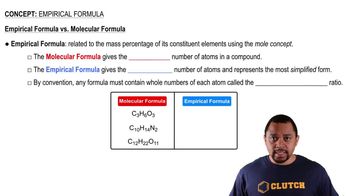
The empirical formula represents the simplest whole-number ratio of elements in a compound, while the molecular formula indicates the actual number of atoms of each element in a molecule. To determine the molecular formula, one often starts with the empirical formula and uses molar mass data to find the actual composition.
Recommended video:
Guided course
02:26
Empirical vs Molecular Formula

Ideal Gas Law

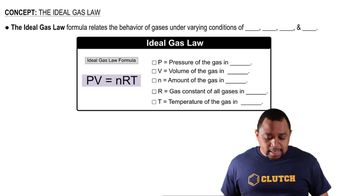
The Ideal Gas Law, expressed as PV = nRT, relates the pressure (P), volume (V), number of moles (n), gas constant (R), and temperature (T) of a gas. This law is essential for calculating the number of moles of cyclopropane in the given conditions, which is necessary for determining its molecular formula.
Recommended video:
Guided course
01:15
Ideal Gas Law Formula

Stoichiometry

Stoichiometry involves the calculation of reactants and products in chemical reactions based on the conservation of mass. In this context, it helps in determining the mass of carbon and hydrogen in cyclopropane from its percentage composition, which is crucial for deriving the empirical formula and subsequently the molecular formula.
Recommended video:
Guided course
01:16
Stoichiometry Concept