

Ch.10 - Gases
Brown - Chemistry: The Central Science 14th Edition
Brown14th EditionChemistry: The Central ScienceISBN: 9780134414232Not the one you use?Change textbook
Chapter 10, Problem 5

Which of the following statements best explains why nitrogen gas at STP is less dense than Xe gas at STP? (a) Because Xe is a noble gas, there is less tendency for the Xe atoms to repel one another, so they pack more densely in the gaseous state. (b) Xe atoms have a higher mass than N2 molecules. Because both gases at STP have the same number of molecules per unit volume, the Xe gas must be denser. (c) The Xe atoms are larger than N2 molecules and thus take up a larger fraction of the space occupied by the gas. (d) Because the Xe atoms are much more massive than the N2 molecules, they move more slowly and thus exert less upward force on the gas container and make the gas denser.

Verified step by step guidance
1
Step 1: Understand the concept of density in gases. Density is defined as mass per unit volume. At Standard Temperature and Pressure (STP), all gases occupy the same volume per mole, which is 22.4 liters.
Step 2: Recall Avogadro's Law, which states that equal volumes of gases at the same temperature and pressure contain the same number of molecules. Therefore, at STP, 1 mole of any gas will have the same volume.
Step 3: Consider the molar mass of the gases. Nitrogen gas (N2) has a molar mass of approximately 28 g/mol, while xenon (Xe) has a molar mass of approximately 131 g/mol.
Step 4: Compare the masses of the gases. Since both gases occupy the same volume at STP, the gas with the higher molar mass will have a greater mass in that volume, making it denser.
Step 5: Evaluate the options. Option (b) correctly states that Xe atoms have a higher mass than N2 molecules, and since both gases have the same number of molecules per unit volume at STP, the Xe gas must be denser.

Key Concepts

Here are the essential concepts you must grasp in order to answer the question correctly.

Density and Molar Mass

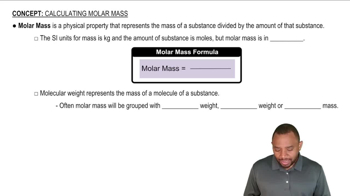
Density is defined as mass per unit volume. In gases, density can be influenced by the molar mass of the gas particles. A higher molar mass typically results in a higher density if the volume is constant. Therefore, comparing the molar masses of nitrogen (N2) and xenon (Xe) is crucial to understanding their relative densities at standard temperature and pressure (STP).
Recommended video:
Guided course
02:11
Molar Mass Concept

Ideal Gas Law

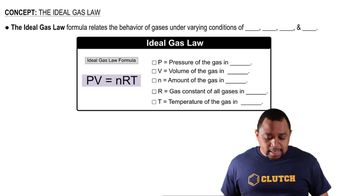
The Ideal Gas Law (PV=nRT) relates pressure (P), volume (V), number of moles (n), gas constant (R), and temperature (T). At STP, gases behave ideally, meaning their properties can be predicted using this law. The law implies that for a given volume and temperature, the density of a gas is directly proportional to its molar mass, which is essential for comparing the densities of N2 and Xe.
Recommended video:
Guided course
01:15
Ideal Gas Law Formula

Kinetic Molecular Theory

Kinetic Molecular Theory explains the behavior of gases in terms of particle motion. It states that gas particles are in constant motion and that their speed is related to temperature. Heavier gas particles, like Xe, move more slowly than lighter ones, like N2, which affects their density and how they occupy space. Understanding this theory helps clarify why Xe is denser than N2 despite being a noble gas.
Recommended video:
Guided course
01:19
Kinetic Molecular Theory