(c) Which type of intermolecular attractive force operates only between the hydrogen atom of a polar bond and a nearby small electronegative atom?
Ch.11 - Liquids and Intermolecular Forces
Brown14th EditionChemistry: The Central ScienceISBN: 9780134414232Not the one you use?Change textbook
Chapter 11, Problem 15b
(b) Which type of intermolecular attractive force operates only between polar molecules?
Verified step by step guidance1
Identify the types of intermolecular forces: London dispersion forces, dipole-dipole interactions, hydrogen bonding, and ion-dipole interactions.
Understand that polar molecules have a permanent dipole moment due to the difference in electronegativity between atoms.
Recognize that dipole-dipole interactions occur between the positive end of one polar molecule and the negative end of another polar molecule.
Note that dipole-dipole interactions are specific to polar molecules because they rely on the presence of a permanent dipole.
Conclude that the type of intermolecular attractive force that operates only between polar molecules is dipole-dipole interactions.

Verified video answer for a similar problem:
This video solution was recommended by our tutors as helpful for the problem above.
Video duration:
1mWas this helpful?
Key Concepts
Here are the essential concepts you must grasp in order to answer the question correctly.
Intermolecular Forces
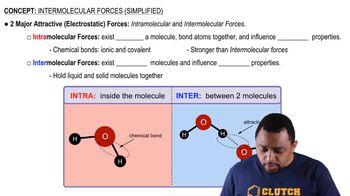
Intermolecular forces are the attractive forces that occur between molecules, influencing their physical properties such as boiling and melting points. These forces are weaker than covalent or ionic bonds and include various types such as hydrogen bonding, dipole-dipole interactions, and London dispersion forces.
Recommended video:
Guided course
Intermolecular vs Intramolecular Forces
Polar Molecules
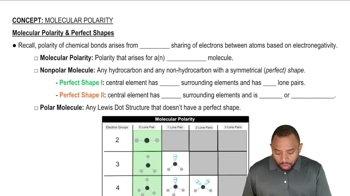
Polar molecules have an uneven distribution of electron density, resulting in a partial positive charge on one end and a partial negative charge on the other. This polarity arises from differences in electronegativity between atoms, leading to dipole moments that affect how these molecules interact with each other.
Recommended video:
Guided course
Molecular Polarity
Dipole-Dipole Interactions
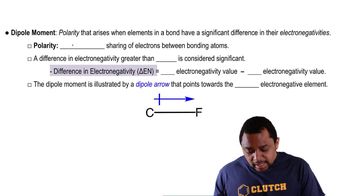
Dipole-dipole interactions are a type of intermolecular force that occurs specifically between polar molecules. These forces arise from the attraction between the positive end of one polar molecule and the negative end of another, contributing to the overall stability and properties of polar substances.
Recommended video:
Guided course
Dipole Moment
Related Practice
Textbook Question
422
views
Textbook Question
At standard temperature and pressure, the molar volumes of Cl2 and NH3 gases are 22.06 and 22.40 L, respectively. (c) The densities of crystalline Cl2 and NH3 at 160 K are 2.02 and 0.84 g/cm3, respectively. Calculate their molar volumes.
2410
views
Textbook Question
At standard temperature and pressure, the molar volumes of Cl2 and NH3 gases are 22.06 and 22.40 L, respectively (d) Are the molar volumes in the solid state as similar as they are in the gaseous state? Explain.
543
views
Textbook Question
(a) Which type of intermolecular attractive force operates between all molecules?
506
views
Textbook Question
(b) Which of these kinds of interactions are broken when a liquid is converted to a gas?
403
views