(b) A flask of water is connected to a vacuum pump. A few moments after the pump is turned on, the water begins to boil. After a few minutes, the water begins to freeze. Explain why these processes occur.
Ch.11 - Liquids and Intermolecular Forces
Brown14th EditionChemistry: The Central ScienceISBN: 9780134414232Not the one you use?Change textbook
Chapter 11, Problem 81
Use the normal boiling points propane (C3H8) -42.1 °C butane (C4H10) -0.5 °C pentane (C5H12) 36.1 °C hexane (C6H14) 68.7 °C heptane (C7H16) 98.4 °C to estimate the normal boiling point of octane (C8H18). Explain the trend in the boiling points.
Verified step by step guidance1
Identify the trend in boiling points as the number of carbon atoms in the alkane increases. Notice that as the carbon chain lengthens from propane (C3H8) to heptane (C7H16), the boiling point rises.
Plot the given data points (number of carbons vs. boiling points) on a graph to visually assess the trend. This can help in predicting the boiling point for octane (C8H18).
Apply a method of linear extrapolation using the boiling points of the closest known higher hydrocarbons, such as hexane, heptane, and possibly pentane, to estimate the boiling point of octane.
Calculate the average increase in boiling point per additional carbon atom based on the data from the known alkanes. Use this average increase to estimate the boiling point of octane by adding this value to the boiling point of heptane.
Consider the molecular interactions and structural implications. As the molecular weight and surface area of the molecules increase, the London dispersion forces become stronger, leading to higher boiling points. This understanding supports the trend observed and the extrapolation made for octane.
Key Concepts
Here are the essential concepts you must grasp in order to answer the question correctly.
Boiling Point and Intermolecular Forces
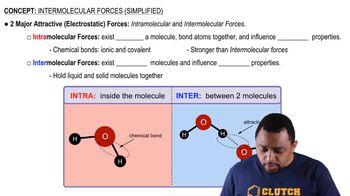
The boiling point of a substance is the temperature at which its vapor pressure equals the atmospheric pressure, allowing it to transition from liquid to gas. This property is significantly influenced by intermolecular forces, such as van der Waals forces, which increase with molecular size and surface area. As the molecular weight of hydrocarbons increases, so do the London dispersion forces, leading to higher boiling points.
Recommended video:
Guided course
Intermolecular vs Intramolecular Forces
Hydrocarbon Structure and Molecular Weight
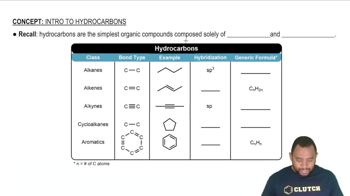
Hydrocarbons are organic compounds consisting solely of hydrogen and carbon. The structure of these molecules, including the number of carbon atoms, directly affects their physical properties. As the number of carbon atoms increases, the molecular weight also increases, which typically results in stronger intermolecular forces and higher boiling points, as seen in the provided data for propane, butane, pentane, hexane, and heptane.
Recommended video:
Guided course
Intro To Hydrocarbons
Trends in Boiling Points of Alkanes
In a series of straight-chain alkanes, the boiling points generally increase with the number of carbon atoms. This trend can be attributed to the increasing surface area and the resultant increase in van der Waals forces. For octane (C8H18), one can estimate its boiling point by observing the pattern in the boiling points of the preceding alkanes, suggesting it will be higher than that of heptane (98.4 °C) due to its larger molecular size.
Recommended video:
Guided course
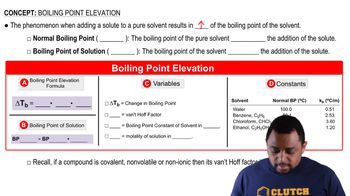
Boiling Point Elevation
Related Practice
Textbook Question
634
views
Textbook Question
Two isomers of the planar compound 1,2-dichloroethylene are shown here.
(a) Which of the two isomers will have the stronger dipole– dipole forces?
585
views
Textbook Question
The table below shows the normal boiling points of benzene and benzene derivatives.
(a) How many of these compounds exhibit dispersion interactions?
347
views
Textbook Question
The following table gives the vapor pressure of hexafluorobenzene (C6F6) as a function of temperature: (a) By plotting these data in a suitable fashion, determine whether the Clausius–Clapeyron equation (Equation 11.1) is obeyed. If it is obeyed, use your plot to determine ∆Hvap for C6F6.
576
views
Textbook Question
The table below shows the normal boiling points of benzene and benzene derivatives. (e) Why is the boiling point of phenol the highest of all?
775
views
1
rank