Ch.11 - Liquids and Intermolecular Forces
Brown - Chemistry: The Central Science 14th Edition
Brown14th EditionChemistry: The Central ScienceISBN: 9780134414232Not the one you use?Change textbook
Chapter 11, Problem 55d

Using the vapor-pressure curves in Figure 11.25, (d) estimate the external pressure at which diethyl ether will boil at 40 °C.

Verified step by step guidance
1
Step 1: Look at the vapor-pressure curve for diethyl ether in Figure 11.25. This graph shows the relationship between the vapor pressure of diethyl ether and temperature.
Step 2: Find 40 °C on the x-axis (temperature axis) of the graph. Draw a line from this point straight up to the curve for diethyl ether.
Step 3: From the point where this line intersects the curve for diethyl ether, draw a line horizontally to the y-axis (pressure axis).
Step 4: The point where this line intersects the y-axis represents the vapor pressure of diethyl ether at 40 °C. This is also the external pressure at which diethyl ether will boil at 40 °C, because a substance boils when its vapor pressure equals the external pressure.
Step 5: Read off the value of the external pressure from the y-axis. This is the estimated external pressure at which diethyl ether will boil at 40 °C.

Verified video answer for a similar problem:

This video solution was recommended by our tutors as helpful for the problem above.
Video duration:
32s
Was this helpful?

Key Concepts

Here are the essential concepts you must grasp in order to answer the question correctly.

Vapor Pressure

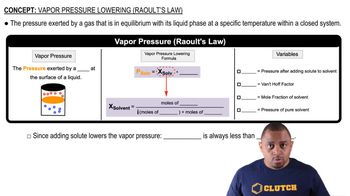
Vapor pressure is the pressure exerted by a vapor in equilibrium with its liquid or solid phase at a given temperature. It indicates how readily a substance will evaporate; higher vapor pressure means a substance will boil at lower temperatures. Understanding vapor pressure is crucial for determining boiling points under varying external pressures.
Recommended video:
Guided course
02:40
Raoult's Law and Vapor Pressure

Boiling Point

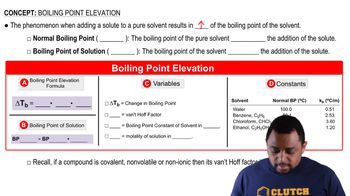
The boiling point of a substance is the temperature at which its vapor pressure equals the external pressure surrounding the liquid. At this point, the liquid turns into vapor. For diethyl ether to boil at 40 °C, the external pressure must match its vapor pressure at that temperature, which can be found using vapor-pressure curves.
Recommended video:
Guided course
03:05
Boiling Point Elevation

Phase Equilibrium

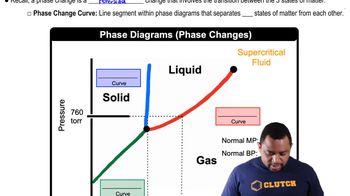
Phase equilibrium refers to the state where the rates of the forward and reverse processes of phase changes (like evaporation and condensation) are equal. In the context of boiling, it is the balance between the liquid and vapor phases of a substance. Understanding this concept helps in analyzing how changes in temperature and pressure affect the state of a substance.
Recommended video:
Guided course
03:22
Phase Changes in Diagrams
Related Practice
Textbook Question

Appendix B lists the vapor pressure of water at various external pressures. (c) A city at an altitude of 5000 ft above sea level has a barometric pressure of 633 torr. To what temperature would you have to heat water to boil it in this city?

759
views
Textbook Question

(a) Two pans of water are on different burners of a stove. One pan of water is boiling vigorously, while the other is boiling gently. What can be said about the temperature of the water in the two pans?

663
views
Textbook Question

You are high up in the mountains and boil water to make some tea. However, when you drink your tea, it is not as hot as it should be. You try again and again, but the water is just not hot enough to make a hot cup of tea. Which is the best explanation for this result? (a) High in the mountains, it is probably very dry, and so the water is rapidly evaporating from your cup and cooling it. (b) High in the mountains, it is probably very windy, and so the water is rapidly evaporating from your cup and cooling it. (c) High in the mountains, the air pressure is significantly less than 1 atm, so the boiling point of water is much lower than at sea level. (d) High in the mountains, the air pressure is significantly less than 1 atm, so the boiling point of water is much higher than at sea level.

1034
views
Textbook Question
(b) Could you measure the triple point of water by measuring the temperature in a vessel in which water vapor, liquid water, and ice are in equilibrium under 1 atm of air? Explain.
690
views