
Textbook Question
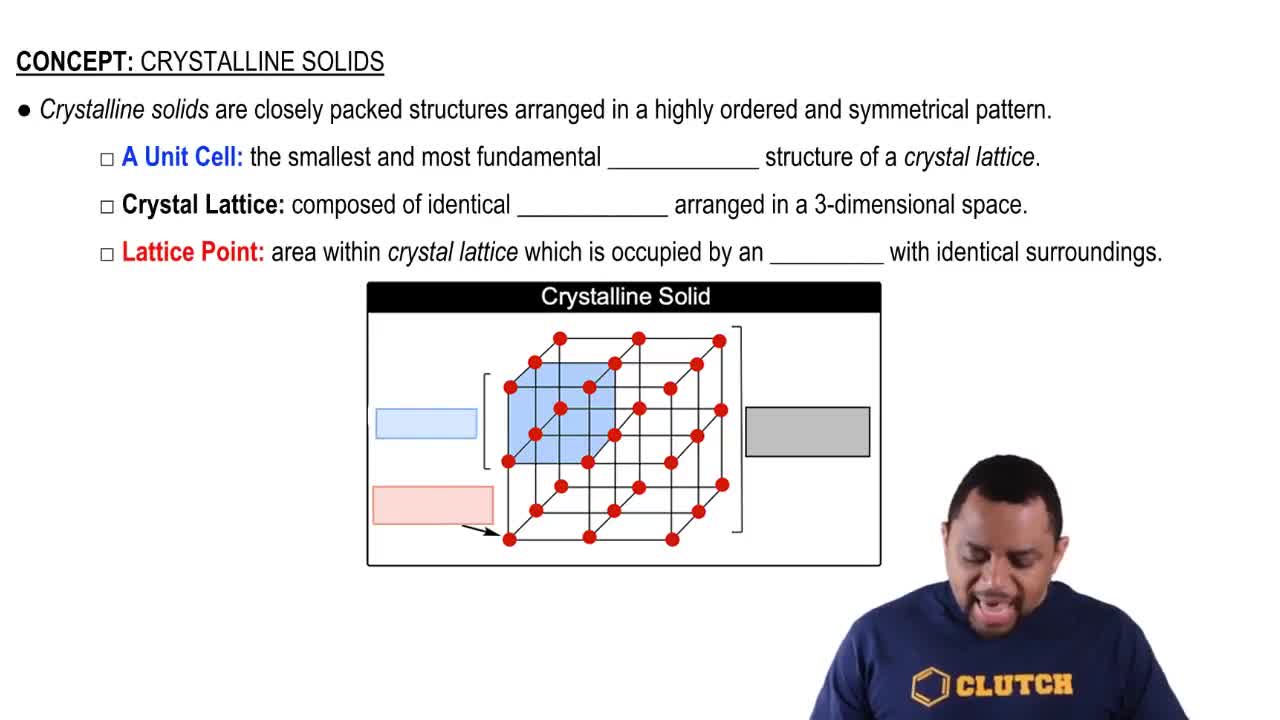
Silicon is the fundamental component of integrated circuits. Si has the same structure as diamond. (a) Is Si a molecular, metallic, ionic, or covalent-network solid?
354
views

 Verified step by step guidance
 01:31
01:31
 01:42
01:42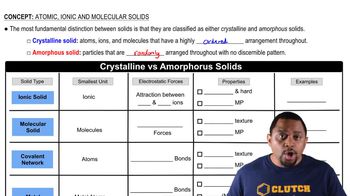 04:13
04:13Silicon is the fundamental component of integrated circuits. Si has the same structure as diamond. (a) Is Si a molecular, metallic, ionic, or covalent-network solid?
What kinds of attractive forces exist between particles (atoms, molecules, or ions) in (a) molecular crystals?
Which type (or types) of crystalline solid is characterized by each of the following? (a) High mobility of electrons throughout the solid;
The accompanying image shows photoluminescence from four different samples of CdTe nanocrystals, each embedded in a polymer matrix. The photoluminescence occurs because the samples are being irradiated by a UV light source. The nanocrystals in each vial have different average sizes. The sizes are 4.0, 3.5, 3.2, and 2.8 nm. (a) Which vial contains the 4.0-nm nanocrystals?
Shown here are cartoons of two different polymers. Which one would have the higher melting point?
What kinds of attractive forces exist between particles (atoms, molecules, or ions) in (d) and metallic crystals?