By referring to Figure 13.15, determine whether the addition of 40.0 g of each of the following ionic solids to 100 g of water at 40 °C will lead to a saturated solution: (d) Pb(NO3)2.
Ch.13 - Properties of Solutions
Brown14th EditionChemistry: The Central ScienceISBN: 9780134414232Not the one you use?Change textbook
Chapter 13, Problem 27
Consider water and glycerol, CH2(OH)CH(OH)CH2OH. (b) List the intermolecular attractions that occur between a water molecule and a glycerol molecule.
Verified step by step guidance1
Identify the types of intermolecular forces present in water. Water molecules exhibit hydrogen bonding due to the presence of highly electronegative oxygen atoms bonded to hydrogen atoms.
Identify the types of intermolecular forces present in glycerol. Glycerol, with its three hydroxyl (OH) groups, also exhibits hydrogen bonding due to the presence of oxygen atoms bonded to hydrogen atoms.
Consider the interaction between a water molecule and a glycerol molecule. Both molecules can form hydrogen bonds with each other due to the presence of hydroxyl groups.
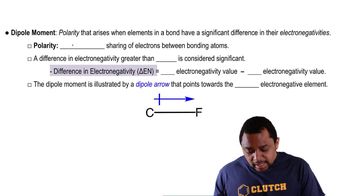
Recognize that in addition to hydrogen bonding, there are also dipole-dipole interactions between the polar regions of the water and glycerol molecules.
Acknowledge that while hydrogen bonding is the dominant force, London dispersion forces (induced dipole-induced dipole interactions) are also present, although they are weaker compared to hydrogen bonds.
Key Concepts
Here are the essential concepts you must grasp in order to answer the question correctly.
Hydrogen Bonding
Hydrogen bonding is a strong type of dipole-dipole attraction that occurs when a hydrogen atom covalently bonded to a highly electronegative atom, such as oxygen, interacts with another electronegative atom. In the case of water and glycerol, the hydroxyl (–OH) groups in both molecules can form hydrogen bonds, significantly influencing their physical properties and solubility.
Dipole-Dipole Interactions
Dipole-dipole interactions occur between polar molecules, where the positive end of one molecule is attracted to the negative end of another. Both water and glycerol are polar due to their hydroxyl groups, leading to these interactions, which contribute to the overall intermolecular forces present in the mixture.
Recommended video:
Guided course
Dipole Moment
Van der Waals Forces
Van der Waals forces are weak attractions that occur between all molecules, regardless of polarity. These forces arise from temporary dipoles that occur when electron distributions within molecules fluctuate. While they are weaker than hydrogen bonds and dipole-dipole interactions, they still play a role in the overall intermolecular attractions between water and glycerol.
Recommended video:
Guided course
Van der Waals Equation
Related Practice
Textbook Question
875
views
Textbook Question
By referring to Figure 13.15, determine the mass of each of the following salts required to form a saturated solution in 250 g of water at 30 °C: (c) Ce2(SO4)3.
967
views
2
rank
Textbook Question
By referring to Figure 13.15, determine the mass of each of the following salts required to form a saturated solution in 250 g of water at 30 °C: (b) Pb(NO3)2,
438
views
Textbook Question
Which of the following in each pair is likely to be more soluble in water: (a) cyclohexane (C6H12) or glucose (C6H12O6),
1027
views
Textbook Question
Which of the following in each pair is likely to be more soluble in hexane, C6H14: (a) CCl4 or CaCl2, (b) benzene (C6H6) or glycerol, CH2(OH)CH(OH)CH2OH, (c) octanoic acid, CH3CH2CH2CH2CH2CH2CH2COOH, or acetic acid, CH3COOH? Explain your answer in each case.
2190
views