
Describe how you would prepare each of the following aqueous solutions, starting with solid KBr: (d) a 0.150 M solution of KBr that contains just enough KBr to precipitate 16.0 g of AgBr from a solution containing 0.480 mol of AgNO3.
Ch.13 - Properties of Solutions
Brown14th EditionChemistry: The Central ScienceISBN: 9780134414232Not the one you use?Change textbook
Chapter 13, Problem 54c
Describe how you would prepare each of the following aqueous solutions: (c) 1.20 L of a solution that is 15.0% Pb(NO3)2 by mass (the density of the solution is 1.16 g/mL), starting with solid solute;
Verified step by step guidance1
Calculate the total mass of the solution using the volume and density. Use the formula: \( \text{mass} = \text{volume} \times \text{density} \). Convert the volume from liters to milliliters first, since the density is given in g/mL.
Determine the mass of Pb(NO3)2 required for the solution. Since the solution is 15.0% Pb(NO3)2 by mass, use the formula: \( \text{mass of Pb(NO3)}_2 = \text{total mass of solution} \times 0.15 \).
Weigh out the calculated mass of solid Pb(NO3)2 using a balance.
Calculate the mass of water needed to make the solution. Subtract the mass of Pb(NO3)2 from the total mass of the solution to find the mass of water.
Dissolve the weighed Pb(NO3)2 in the calculated mass of water. Stir the mixture until the solute is completely dissolved, ensuring the solution is homogeneous.

Verified video answer for a similar problem:
This video solution was recommended by our tutors as helpful for the problem above.
Video duration:
2mWas this helpful?
Key Concepts
Here are the essential concepts you must grasp in order to answer the question correctly.
Mass Percent Concentration
Mass percent concentration is a way to express the concentration of a solute in a solution, calculated as the mass of the solute divided by the total mass of the solution, multiplied by 100. In this case, a 15.0% mass concentration of Pb(NO3)2 means that there are 15 grams of lead(II) nitrate for every 100 grams of the solution.
Density and Volume Relationship
Density is defined as mass per unit volume and is crucial for converting between mass and volume in solution preparation. Given the density of the solution (1.16 g/mL), you can calculate the total mass of the solution by multiplying the volume (1.20 L or 1200 mL) by the density, which helps in determining how much solute is needed.
Recommended video:
Guided course
Relationship of Volume and Moles Example
Stoichiometry in Solution Preparation
Stoichiometry involves the calculation of reactants and products in chemical reactions, and it is essential for preparing solutions. In this context, once the mass of Pb(NO3)2 needed is determined, stoichiometric principles can be applied to ensure the correct amount of solid solute is measured and dissolved in the appropriate volume of solvent to achieve the desired concentration.
Recommended video:
Guided course
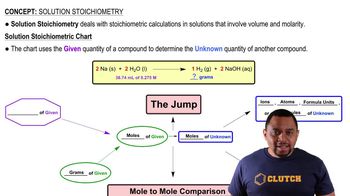
Solution Stoichiometry
Related Practice
Textbook Question
781
views
Textbook Question
Commercial concentrated aqueous ammonia is 28% NH3 by mass and has a density of 0.90 g/mL. What is the molarity of this solution?
13
views
Textbook Question
Commercial concentrated aqueous ammonia is 28% NH3 by mass and has a density of 0.90 g/mL. What is the molarity of this solution?
2228
views
Textbook Question
Describe how you would prepare each of the following aqueous solutions: (a) 1.50 L of 0.110 M 1NH422SO4 solution, starting with solid 1NH422SO4;
1170
views
1
rank
Textbook Question
Commercial aqueous nitric acid has a density of 1.42 g/mL and is 16 M. Calculate the percent HNO3 by mass in the solution.
2791
views
1
comments
Textbook Question
Describe how you would prepare each of the following aqueous solutions, starting with solid KBr: (c) 1.85 L of a solution that is 12.0% KBr by mass (the density of the solution is 1.10 g/mL)
