

Breathing air that contains 4.0 % by volume CO2 over time causes rapid breathing, throbbing headache, and nausea, among other symptoms. What is the concentration of CO2 in such air in terms of (b) molarity, assuming 1 atm pressure and a body temperature of 37 °C?
During a person’s typical breathing cycle, the CO2 concentration in the expired air rises to a peak of 4.6% by volume. (b) What is the molarity of the CO2 in the expired air at its peak, assuming a body temperature of 37 °C?
Verified step by step guidanceKey Concepts
Molarity
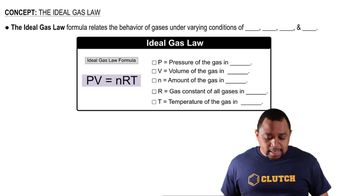
Ideal Gas Law
Body Temperature and Gas Behavior
Brass is a substitutional alloy consisting of a solution of copper and zinc. A particular sample of red brass consisting of 80.0 % Cu and 20.0 % Zn by mass has a density of 8750 kg/m3. (a) What is the molality of Zn in the solid solution?
Commercial concentrated aqueous ammonia is 28% NH3 by mass and has a density of 0.90 g/mL. What is the molarity of this solution?
Brass is a substitutional alloy consisting of a solution of copper and zinc. A particular sample of red brass consisting of 80.0 % Cu and 20.0 % Zn by mass has a density of 8750 kg/m3. (b) What is the molarity of Zn in the solution?
Breathing air that contains 4.0 % by volume CO2 over time causes rapid breathing, throbbing headache, and nausea, among other symptoms. What is the concentration of CO2 in such air in terms of (a) mol percentage,
