
Textbook Question
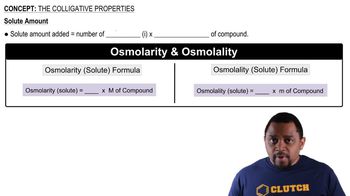
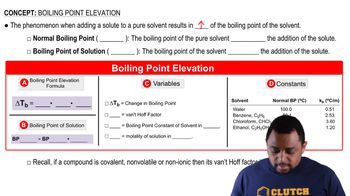
(a) Does a 0.10 m aqueous solution of NaCl have a higher boiling point, a lower boiling point, or the same boiling point as a 0.10 m aqueous solution of C6H12O6?
1109
views

 Verified step by step guidance
 01:26
01:26
 03:05
03:05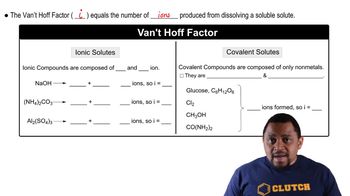 02:50
02:50Using data from Table 13.3, calculate the freezing and boiling points of each of the following solutions: (a) 0.22 m glycerol (C3H8O3) in ethanol, (b) 0.240 mol of naphthalene (C10H8) in 2.45 mol of chloroform, (c) 1.50 g NaCl in 0.250 kg of water, (d) 2.04 g KBr and 4.82 g of glucose (C6H12O6) in 188 g of water.
At 20 °C, the vapor pressure of benzene (C6H6) is 75 torr, and that of toluene (C7H8) is 22 torr. Assume that benzene and toluene form an ideal solution. (b) What is the mole fraction of benzene in the vapor above the solution described in part (a)?
Using data from Table 13.3, calculate the freezing and boiling points of each of the following solutions: (a) 0.25 m glucose in ethanol; (b) 20.0 g of decane, C10H22, in 50.0 g CHCl3; (c) 3.50 g NaOH in 175 g of water, (d) 0.45 mol ethylene glycol and 0.15 mol KBr in 150 g H2O.