
Textbook Question
The density of acetonitrile (CH3CN) is 0.786 g/mL and the density of methanol (CH3OH) is 0.791 g/mL. A solution is made by dissolving 22.5 mL of CH3OH in 98.7 mL of CH3CN. (b) What is the molality of the solution?
1014
views

 Verified step by step guidance
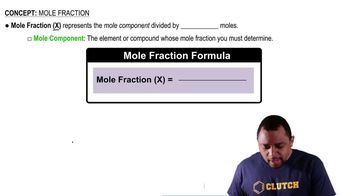
 00:36
00:36
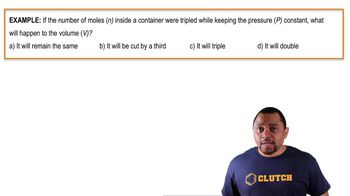 01:09
01:09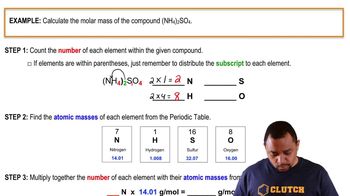 03:12
03:12The density of acetonitrile (CH3CN) is 0.786 g/mL and the density of methanol (CH3OH) is 0.791 g/mL. A solution is made by dissolving 22.5 mL of CH3OH in 98.7 mL of CH3CN. (b) What is the molality of the solution?
Calculate the number of moles of solute present in each of the following aqueous solutions: (b) 86.4 g of 0.180 m KCl,
The density of acetonitrile (CH3CN) is 0.786 g/mL and the density of methanol (CH3OH) is 0.791 g/mL. A solution is made by dissolving 22.5 mL of CH3OH in 98.7 mL of CH3CN. (c) Assuming that the volumes are additive, what is the molarity of CH3OH in the solution?
Ascorbic acid (vitamin C, C6H8O6) is a water-soluble vitamin. A solution containing 80.5 g of ascorbic acid dissolved in 210 g of water has a density of 1.22 g/mL at 55 °C. Calculate (d) the molarity of ascorbic acid in this solution.
Calculate the number of moles of solute present in each of the following aqueous solutions: (a) 600 mL of 0.250 M SrBr2,
Calculate the number of moles of solute present in each of the following aqueous solutions: (c) 124.0 g of a solution that is 6.45% glucose (C6H12O6) by mass.