
Aerosols are important components of the atmosphere. Does the presence of aerosols in the atmosphere increase or decrease the amount of sunlight that arrives at the Earth's surface, compared to an 'aerosol-free' atmosphere? Explain your reasoning.
Ch.13 - Properties of Solutions
Brown14th EditionChemistry: The Central ScienceISBN: 9780134414232Not the one you use?Change textbook
Chapter 13, Problem 83
The osmotic pressure of a 0.010 M aqueous solution of CaCl2 is found to be 0.674 atm at 25 °C. Calculate the van't Hoff factor, i, for the solution.
Verified step by step guidance1
Identify the formula for osmotic pressure: \( \Pi = iMRT \), where \( \Pi \) is the osmotic pressure, \( i \) is the van't Hoff factor, \( M \) is the molarity, \( R \) is the ideal gas constant, and \( T \) is the temperature in Kelvin.
Convert the temperature from Celsius to Kelvin: \( T = 25 + 273.15 \).
Use the given values: \( \Pi = 0.674 \) atm, \( M = 0.010 \) M, \( R = 0.0821 \) L·atm/mol·K, and the converted temperature \( T \).
Rearrange the formula to solve for the van't Hoff factor \( i \): \( i = \frac{\Pi}{MRT} \).
Substitute the known values into the rearranged formula to calculate \( i \).

Verified video answer for a similar problem:
This video solution was recommended by our tutors as helpful for the problem above.
Video duration:
3mWas this helpful?
Key Concepts
Here are the essential concepts you must grasp in order to answer the question correctly.
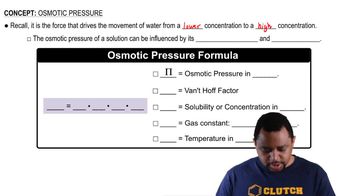
Osmotic Pressure
Osmotic pressure is the pressure required to prevent the flow of solvent into a solution through a semipermeable membrane. It is directly proportional to the concentration of solute particles in the solution and can be calculated using the formula π = iCRT, where π is the osmotic pressure, i is the van't Hoff factor, C is the molarity of the solution, R is the ideal gas constant, and T is the temperature in Kelvin.
Recommended video:
Guided course
Osmotic Pressure Formula
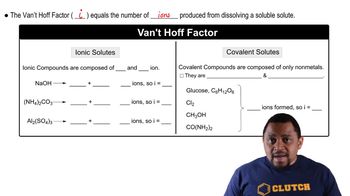
van't Hoff Factor (i)
The van't Hoff factor, denoted as i, represents the number of particles into which a solute dissociates in solution. For ionic compounds, i is greater than 1, as they separate into multiple ions. For example, CaCl2 dissociates into one calcium ion (Ca²⁺) and two chloride ions (Cl⁻), resulting in a van't Hoff factor of 3. This factor is crucial for calculating colligative properties like osmotic pressure.
Recommended video:
Guided course
Van't Hoff Factor
Colligative Properties
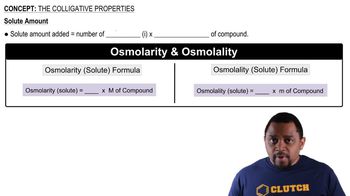
Colligative properties are properties of solutions that depend on the number of solute particles rather than their identity. These properties include boiling point elevation, freezing point depression, vapor pressure lowering, and osmotic pressure. Understanding colligative properties is essential for predicting how solute concentration affects the physical behavior of solutions, particularly in the context of osmotic pressure calculations.
Recommended video:
Guided course
Colligative Properties
Related Practice
Textbook Question
507
views
Textbook Question
Lysozyme is an enzyme that breaks bacterial cell walls. A solution containing 0.150 g of this enzyme in 210 mL of solution has an osmotic pressure of 0.953 torr at 25 °C. What is the molar mass of lysozyme?
2030
views
Textbook Question
A dilute aqueous solution of an organic compound soluble in water is formed by dissolving 2.35 g of the compound in water to form 0.250 L of solution. The resulting solution has an osmotic pressure of 0.605 atm at 25 °C. Assuming that the organic compound is a nonelectrolyte, what is its molar mass?
1036
views
Textbook Question
Lauryl alcohol is obtained from coconut oil and is used to make detergents. A solution of 5.00 g of lauryl alcohol in 0.100 kg of benzene freezes at 4.1 °C. What is the molar mass of lauryl alcohol from this data?
2267
views
