
(a) The activation energy for the isomerization of methyl isonitrile (Figure 14.6) is 160 kJ>mol. Calculate the fraction of methyl isonitrile molecules that has an energy equal to or greater than the activation energy at 500 K. (b) Calculate this fraction for a temperature of 520 K. What is the ratio of the fraction at 520 K to that at 500 K?
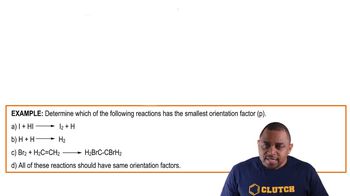
(a) In which of the following reactions would you expect the orientation factor to be least important in leading to the reaction: NO + O → NO2 or H + Cl → HCl? (b) Does the orientation factor depend on temperature?
Verified step by step guidanceKey Concepts
Orientation Factor
Collision Theory
Temperature Dependence
The gas-phase decomposition of NO2, 2 NO2(g) → 2 NO(g) + O2(g), is studied at 383°C, giving the following data:
Time (s) [NO2] (M)
0.0 0.100
5.0 0.017
10.0 0.0090
15.0 0.0062
20.0 0.0047
(a) Is the reaction first order or second order with respect to the concentration of NO2?
(c) Predict the reaction rates at the beginning of the reaction for initial concentrations of 0.200 M, 0.100 M, and 0.050 M NO2.
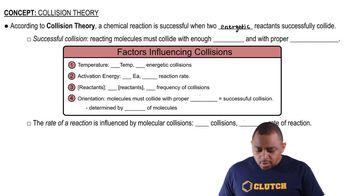
(a) What factors determine whether a collision between two molecules will lead to a chemical reaction?
Calculate the fraction of atoms in a sample of argon gas at 400 K that has an energy of 10.0 kJ or greater.
The gas-phase reaction Cl(g) + HBr(g) → HCl(g) + Br(g) has an overall energy change of -66 kJ. The activation energy for the reaction is 7 kJ. (a) Sketch the energy profile for the reaction, and label Ea and ΔE.
