
From the following data for the first-order gas-phase isomerization of CH3NC at 215 C, calculate the firstorder rate constant and half-life for the reaction: Time (s) Pressure CH3nC (torr) 0 502 2000 335 5000 180 8000 95.5 12,000 41.7 15,000 22.4
Ch.14 - Chemical Kinetics
Brown14th EditionChemistry: The Central ScienceISBN: 9780134414232Not the one you use?Change textbook
Chapter 14, Problem 47c
Consider the data presented in Exercise 14.19. (c) What is the half-life for the reaction?

Verified step by step guidance1
Step 1: Identify the initial concentration of substance C at time t=0, which is 0.045 moles.
Step 2: Determine the concentration of substance C at various time intervals from the table provided.
Step 3: Calculate the time it takes for the concentration of substance C to decrease to half of its initial value (0.045/2 = 0.0225 moles).
Step 4: Compare the calculated half concentration with the values in the table to find the corresponding time.
Step 5: The time at which the concentration of substance C is closest to 0.0225 moles is the half-life of the reaction.
Key Concepts
Here are the essential concepts you must grasp in order to answer the question correctly.
Half-life
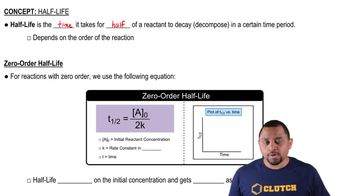
Half-life is the time required for the concentration of a reactant to decrease to half of its initial value. In chemical kinetics, it is a crucial concept for understanding the rate of a reaction and is particularly useful for first-order reactions, where the half-life remains constant regardless of the initial concentration.
Recommended video:
Guided course
Zero-Order Half-life
Reaction Rate
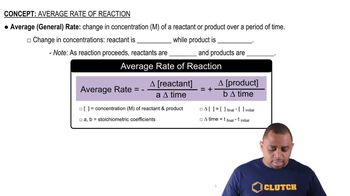
The reaction rate is a measure of how quickly reactants are converted into products in a chemical reaction. It can be expressed in terms of the change in concentration of a reactant or product over time. Understanding the reaction rate is essential for calculating half-lives and predicting how long a reaction will take to reach a certain point.
Recommended video:
Guided course
Average Rate of Reaction
Integrated Rate Laws
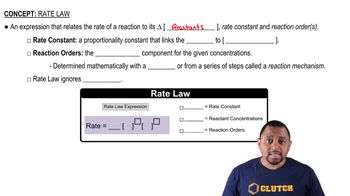
Integrated rate laws relate the concentration of reactants or products to time, allowing for the calculation of concentrations at any given time. For first-order reactions, the integrated rate law can be used to determine the half-life and is expressed as ln([A]0/[A]) = kt, where [A]0 is the initial concentration, [A] is the concentration at time t, and k is the rate constant.
Recommended video:
Guided course
Rate Law Fundamentals
Related Practice
Textbook Question
1191
views
Textbook Question
The gas-phase decomposition of NO2, 2 NO2(g) → 2 NO(g) + O2(g), is studied at 383°C, giving the following data:
Time (s) [NO2] (M)
0.0 0.100
5.0 0.017
10.0 0.0090
15.0 0.0062
20.0 0.0047
(a) Is the reaction first order or second order with respect to the concentration of NO2?
(c) Predict the reaction rates at the beginning of the reaction for initial concentrations of 0.200 M, 0.100 M, and 0.050 M NO2.
1744
views
Textbook Question
Consider the data presented in Exercise 14.19. (a) By using appropriate graphs, determine whether the reaction is first order or second order.
