Ch.14 - Chemical Kinetics
Brown - Chemistry: The Central Science 14th Edition
Brown14th EditionChemistry: The Central ScienceISBN: 9780134414232Not the one you use?Change textbook
Chapter 14, Problem 95a

The reaction 2 NO2 → 2 NO + O2 has the rate constant k = 0.63 M-1s-1. (a) Based on the units for k, is the reaction first or second order in NO2?

Verified step by step guidance
1
Step 1: Understand the relationship between the rate constant units and the order of the reaction. For a reaction of the form A → products, the rate law is typically expressed as rate = k[A]^n, where n is the order of the reaction.
Step 2: Recall that the units of the rate constant k depend on the order of the reaction. For a first-order reaction, the units of k are s^-1. For a second-order reaction, the units of k are M^-1s^-1.
Step 3: Examine the given units for the rate constant k, which are M^-1s^-1. These units are characteristic of a second-order reaction.
Step 4: Conclude that the reaction 2 NO2 → 2 NO + O2 is second order with respect to NO2 based on the units of the rate constant k.
Step 5: Understand that the order of the reaction provides insight into how the concentration of reactants affects the rate of the reaction. In this case, the rate is proportional to the square of the concentration of NO2.

Verified video answer for a similar problem:

This video solution was recommended by our tutors as helpful for the problem above.
Video duration:
43s
Was this helpful?

Key Concepts

Here are the essential concepts you must grasp in order to answer the question correctly.

Order of Reaction

The order of a reaction refers to the power to which the concentration of a reactant is raised in the rate law. It indicates how the rate of reaction depends on the concentration of reactants. For example, a first-order reaction depends linearly on the concentration of one reactant, while a second-order reaction depends on the square of the concentration of one reactant or the product of the concentrations of two reactants.
Recommended video:
Guided course
00:36
Average Bond Order

Rate Constant (k)

The rate constant (k) is a proportionality factor in the rate equation that relates the rate of a reaction to the concentrations of the reactants. Its units vary depending on the order of the reaction; for a second-order reaction, the units are typically M<sup>-1</sup>s<sup>-1</sup>. Understanding the units of k helps determine the order of the reaction and how concentration changes affect the reaction rate.
Recommended video:
Guided course
01:14
Equilibrium Constant K

Units of Rate Constants

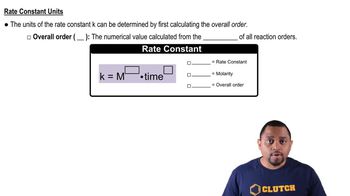
The units of the rate constant provide insight into the reaction order. For zero-order reactions, k has units of M/s; for first-order reactions, k has units of s<sup>-1</sup>; and for second-order reactions, k has units of M<sup>-1</sup>s<sup>-1</sup>. By analyzing the units of k, one can deduce the order of the reaction, which is crucial for understanding the kinetics of the reaction.
Recommended video:
Guided course
00:45
Rate Constant Units
Related Practice
Textbook Question

The reaction 2 NO(g) + O2(g) → 2 NO2 (g) is second order in NO and first order in O2. When [NO] = 0.040 M, and [O2] = 0.035 M, the observed rate of disappearance of NO is 9.3⨉10-5 M/s. (d) What would happen to the rate if the concentration of NO were increased by a factor of 1.8?

Textbook Question

Consider two reactions. Reaction (1) has a constant halflife, whereas reaction (2) has a half-life that gets longer as the reaction proceeds. What can you conclude about the rate laws of these reactions from these observations?

588
views
Textbook Question

The reaction 2 NO2 → 2 NO + O2 has the rate constant k = 0.63 M-1s-1.

(b) If the initial concentration of NO2 is 0.100 M, how would you determine how long it would take for the concentration to decrease to 0.025 M?

1326
views
Textbook Question

Consider the following reaction between mercury(II) chloride and oxalate ion:

2 HgCl2(aq) + C2O42-(aq) → 2 Cl-(aq) + 2 CO2(g) + Hg2Cl2(s)

The initial rate of this reaction was determined for several concentrations of HgCl2 and C2O42-, and the following rate data were obtained for the rate of disappearance of C2O42-:

Experiment [HgCl2] (M) [C2O42-] (M) Rate (M/s)

1 0.164 0.15 3.2 × 10⁻⁵

2 0.164 0.45 2.9 × 10⁻⁴

3 0.082 0.45 1.4 × 10⁻⁴

4 0.246 0.15 4.8 × 10⁻⁵

(b) What is the value of the rate constant with proper units?

(c) What is the reaction rate when the initial concentration of HgCl2 is 0.100 M and that of C2O42- is 0.25 M if the temperature is the same as that used to obtain the data shown?

1291
views