

When 2.00 mol of SO2Cl2 is placed in a 2.00-L flask at 303 K, 56% of the SO2Cl2 decomposes to SO2 and Cl2: SO2Cl2(g) ⇌ SO2(g) + Cl2(g) (c) According to Le Châtelier's principle, would the percent of SO2Cl2 that decomposes increase, decrease or stay the same if the mixture were transferred to a 15.00-L vessel?
Ch.15 - Chemical Equilibrium
Brown14th EditionChemistry: The Central ScienceISBN: 9780134414232Not the one you use?Change textbook
Chapter 15, Problem 76c
A sample of nitrosyl bromide (NOBr) decomposes according to the equation 2 NOBr(g) ⇌ 2 NO(g) + Br2(g) An equilibrium mixture in a 5.00-L vessel at 100°C contains 3.22 g of NOBr, 3.08 g of NO, and 4.19 g of Br2. (c) What was the mass of the original sample of NOBr?
Verified step by step guidance1
Calculate the molar mass of NOBr using the atomic masses of nitrogen (N), oxygen (O), and bromine (Br).
Convert the given mass of NOBr at equilibrium (3.22 g) to moles using its molar mass.
Convert the given masses of NO (3.08 g) and Br2 (4.19 g) to moles using their respective molar masses.
Use the stoichiometry of the balanced equation 2 NOBr ⇌ 2 NO + Br2 to determine the moles of NOBr that decomposed to form the moles of NO and Br2 at equilibrium.
Add the moles of NOBr at equilibrium to the moles of NOBr that decomposed to find the initial moles of NOBr, then convert this back to grams to find the original mass of the NOBr sample.

Verified video answer for a similar problem:
This video solution was recommended by our tutors as helpful for the problem above.
Video duration:
1mWas this helpful?
Key Concepts
Here are the essential concepts you must grasp in order to answer the question correctly.
Stoichiometry
Stoichiometry is the calculation of reactants and products in chemical reactions based on the balanced chemical equation. In this case, the decomposition of nitrosyl bromide (NOBr) involves a specific molar ratio of reactants to products, which is essential for determining the amounts of substances involved in the reaction.
Recommended video:
Guided course
Stoichiometry Concept
Equilibrium
Chemical equilibrium occurs when the rates of the forward and reverse reactions are equal, resulting in constant concentrations of reactants and products. Understanding equilibrium is crucial for analyzing the decomposition of NOBr, as it helps in determining how much of the original sample remains and how much has reacted at a given time.
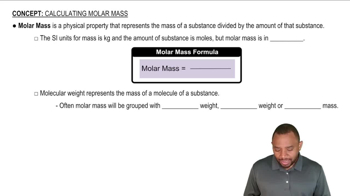
Molar Mass
Molar mass is the mass of one mole of a substance, typically expressed in grams per mole. To find the mass of the original sample of NOBr, it is necessary to calculate the number of moles present in the equilibrium mixture using the molar mass of NOBr, which allows for the determination of the initial mass before decomposition.
Recommended video:
Guided course
Molar Mass Concept
Related Practice
Textbook Question
557
views
Textbook Question
A sample of nitrosyl bromide (NOBr) decomposes according to the equation 2 NOBr(𝑔) ⇌ 2 NO(𝑔) + Br2(𝑔) An equilibrium mixture in a 5.00-L vessel at 100°C contains 3.22 g of NOBr, 3.08 g of NO, and 4.19 g of Br2. (b) What is the total pressure exerted by the mixture of gases?
1082
views
Textbook Question
Consider the hypothetical reaction A(g) ⇌ 2 B(g). A flask is charged with 0.75 atm of pure A, after which it is allowed to reach equilibrium at 0°C. At equilibrium, the partial pressure of A is 0.36 atm. (c) What could we do to maximize the yield of B?
476
views
