Write the chemical equation and the Kb expression for the reaction of each of the following bases with water: (a) propylamine, C3H7NH2
Ch.16 - Acid-Base Equilibria
Brown14th EditionChemistry: The Central ScienceISBN: 9780134414232Not the one you use?Change textbook
Chapter 16, Problem 72
Calculate the molar concentration of OH- in a 0.724 M solution of hypobromite ion BrO-; Kb = 4.0 * 10^-6. What is the pH of this solution?
Verified step by step guidance1
Step 1: Write the equilibrium expression for the base dissociation of hypobromite ion (BrO^-). The reaction is: \[ \text{BrO}^- + \text{H}_2\text{O} \rightleftharpoons \text{OH}^- + \text{HBrO} \]
Step 2: Set up the expression for the base dissociation constant (K_b) using the concentrations of the products and reactants at equilibrium: \[ K_b = \frac{[\text{OH}^-][\text{HBrO}]}{[\text{BrO}^-]} \]
Step 3: Assume that the change in concentration of BrO^- due to dissociation is small compared to the initial concentration. Let x be the concentration of OH^- at equilibrium. Then, \[ [\text{OH}^-] = x, [\text{HBrO}] = x, [\text{BrO}^-] = 0.724 - x \approx 0.724 \]
Step 4: Substitute the equilibrium concentrations into the K_b expression and solve for x: \[ 4.0 \times 10^{-6} = \frac{x^2}{0.724} \]
Step 5: Calculate the pH of the solution using the concentration of OH^- found in the previous step. First, find the pOH: \[ \text{pOH} = -\log[\text{OH}^-] \], then use the relation \[ \text{pH} = 14 - \text{pOH} \] to find the pH.
Key Concepts
Here are the essential concepts you must grasp in order to answer the question correctly.
Equilibrium Constant (Kb)
The base dissociation constant (Kb) quantifies the strength of a base in solution. It is defined as the equilibrium constant for the reaction where a base accepts a proton from water, producing hydroxide ions (OH-) and the conjugate acid. A higher Kb value indicates a stronger base, which in this case helps determine the concentration of OH- ions produced from the hypobromite ion (BrO-).
Recommended video:
Guided course
Equilibrium Constant K
Hydrolysis of Hypobromite Ion
Hypobromite ion (BrO-) can undergo hydrolysis in water, reacting with water to form hydroxide ions (OH-) and hypobromous acid (HBrO). This reaction is essential for calculating the concentration of OH- in the solution. The extent of this reaction is governed by the Kb value, allowing us to set up an equilibrium expression to find the concentration of OH- ions.
Recommended video:
Guided course
Ion Formation
pH and pOH Relationship
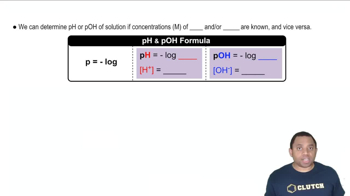
pH is a measure of the acidity or basicity of a solution, defined as the negative logarithm of the hydrogen ion concentration. Conversely, pOH measures the concentration of hydroxide ions. The relationship between pH and pOH is given by the equation pH + pOH = 14 at 25°C. Once the concentration of OH- is determined, pOH can be calculated, and subsequently, pH can be derived from this relationship.
Recommended video:
Guided course
pH and pOH Calculations
Related Practice
Textbook Question
752
views
Textbook Question
Ephedrine, a central nervous system stimulant, is used in nasal sprays as a decongestant. This compound is a weak organic base: C10H15ON1aq2 + H2O1l2 Δ C10H15ONH+1aq2 + OH-1aq2 A 0.035 M solution of ephedrine has a pH of 11.33. (a) What are the equilibrium concentrations of C10H15ON, C10H15ONH+, and OH-?
1229
views
Textbook Question
Ephedrine, a central nervous system stimulant, is used in nasal sprays as a decongestant. This compound is a weak organic base: C10H15ON1aq2 + H2O1l2 Δ C10H15ONH+1aq2 + OH-1aq2 A 0.035 M solution of ephedrine has a pH of 11.33. (b) Calculate Kb for ephedrine.
462
views
Textbook Question
Codeine 1C18H21NO32 is a weak organic base. A 5.0 * 10-3M solution of codeine has a pH of 9.95. Calculate the value of Kb for this substance. What is the pKb for this base?
2159
views
3
rank